How much of your paycheck should you save? Most financial experts recommend saving 20% of your take-home pay, or at least 10% when money is tight. That share is your savings rate: the part of each paycheck set aside for an income-loss fund, retirement savings, a down payment, and other goals before the rest gets spent.
Plenty of Americans never get close. In a GOBankingRates survey of 1,006 U.S. adults, 34% said they put none of their paycheck into savings, and another 32% said they save less than 10%.
That gap costs more than it seems. Savings are what keep a job loss or a dead transmission from turning into credit card debt. They give compound interest years to work, and they let you pay cash for big purchases instead of borrowing.
The 50/30/20 rule is the usual starting point, so this guide begins there, with where it falls short and a method that tends to work better: giving every dollar a job. Then come the practical questions: how to split your savings, what to save for first, how to weigh debt against savings goals, what to do when you're living paycheck to paycheck or 20% isn't realistic, and where to keep the money.
How Much Should You Save From Each Paycheck?
Aim for 20% of each paycheck. Experts recommend saving at least 10% to 20% of your income, with 20% as the most common goal. If that's out of reach for now, start smaller and build up from there.
The right amount for you comes down to four things:
- Your take-home pay
- Your fixed expenses, such as rent, insurance, and loan payments
- Your debt, especially high-interest debt
- Your goals and how soon you need the money
Gross vs. net pay. Budget rules like 50/30/20 work from net pay, the amount that lands in your account after taxes and deductions. Retirement guidelines usually work from gross pay, your income before anything comes out. Both count toward your savings rate.
If 6% of your gross pay already goes into a 401(k), that counts as savings, even if you never see it in your bank account. Add it to what you move into a savings account to get your real savings rate. Not sure what your take-home pay is? Our free paycheck calculator estimates it from your salary or hourly wage and your state.
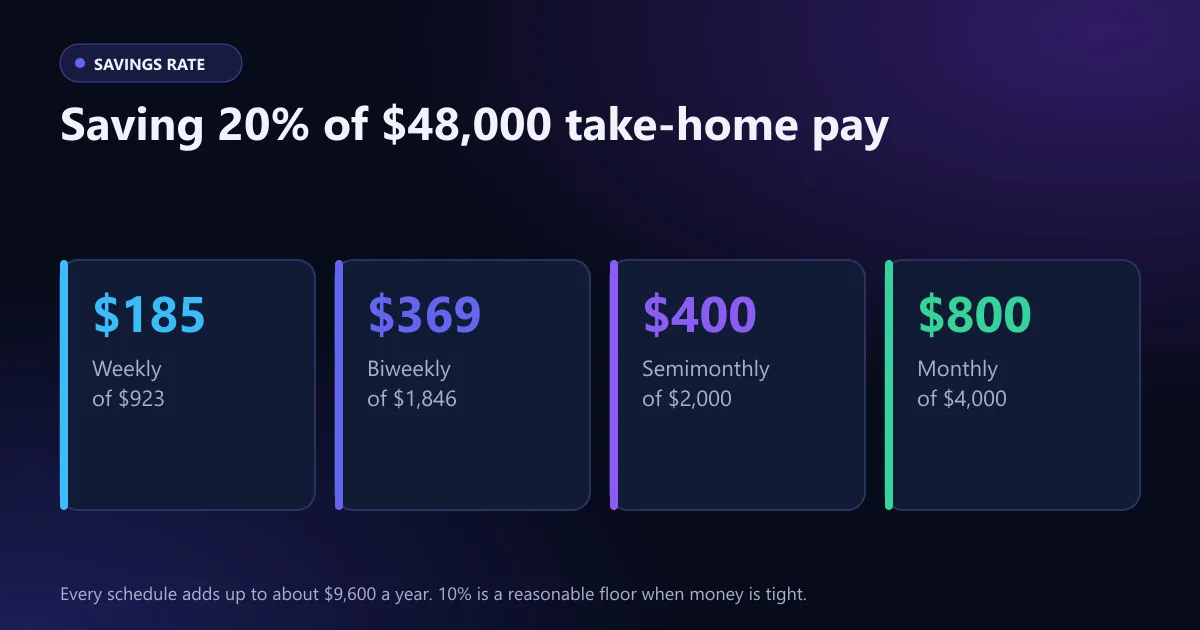
What 20% looks like on $48,000 a year in take-home pay:
| Pay schedule (paychecks a year) | Take-home per paycheck | Save 20% per paycheck |
|---|---|---|
| Weekly (52) | $923 | $185 |
| Biweekly (26) | $1,846 | $369 |
| Semimonthly (24) | $2,000 | $400 |
| Monthly (12) | $4,000 | $800 |
Every schedule works out to about $9,600 a year, or $800 a month. On a $1,000 paycheck, saving 10% to 20% means setting aside $100 to $200.
When you can save more. Low bills leave room to aim higher. Someone in their 20s who lives at home and pays little or no rent can often save 30% to 50% of each paycheck, and a teen or college student with a part-time job may be able to save half.
Money saved in your 20s has the most time to grow, so those years are worth using well. A teen with earned income can even open a custodial Roth IRA, as long as contributions don't exceed what they earned that year. See our guide to when minors have to file taxes for how teen paychecks are taxed.
When you'll save less. A high cost of living, a new baby, or a credit card balance can push your savings rate below 10% for a while. That's fine, as long as you have a plan to bring it back up.
If you're self-employed. Nobody withholds taxes for you, so set aside 25% to 30% of each payment for income taxes and the 15.3% self-employment tax before you save anything. If you're a W-2 employee, your employer already withholds taxes, so check your withholding with the IRS Tax Withholding Estimator instead of saving extra.
Saving With the 50/30/20 Rule and Other Methods
A budgeting method turns a vague goal like "save more" into real numbers. Most rest on one idea, often called "pay yourself first": decide what you'll save before you spend anything. The 50/30/20 rule is the best known. Others include the 80/20 method (save 20%, spend the rest), the 70/20/10 method (70% for spending, 20% for savings, 10% for debt), and the zero-based budget.
The 50/30/20 Rule
The 50/30/20 rule divides your take-home income into three buckets:
- 50% for needs: housing, utilities, groceries, insurance, transportation, and minimum debt payments
- 30% for wants: dining out, travel, streaming, and hobbies
- 20% for savings and debt repayment beyond the minimum payments
Elizabeth Warren popularized the rule in her 2005 book All Your Worth, written with her daughter, Amelia Warren Tyagi, years before Warren became a U.S. senator. On $4,000 a month in take-home pay, the split works out to $2,000 for needs, $1,200 for wants, and $800 for savings.
Its big selling point is that it's easy to remember. Living by it is another matter.
The Problem With the 50/30/20 Budgeting Rule
Think of the 50/30/20 rule as a one-size-fits-all shirt: it fits a few people well, but on most people it pinches somewhere.
This old-school rule is arbitrary. The split is a set of round numbers from a 2005 book, and it knows nothing about your rent, your city, or your income. A renter in a high-cost city can spend 40% of take-home pay on rent alone. That leaves just 10% of the "needs" bucket for groceries, utilities, insurance, and a car payment.
Income skews the math as well. Someone taking home $12,000 a month can save far more than 20% and still live comfortably, while someone taking home $2,500 may struggle to save 10%. Your savings rate should come from your own numbers, not a formula built for everyone.
Weighing needs vs. wants is not helpful. Is your phone a need or a want? What about internet, a reliable car, or the gym membership that keeps your back from hurting? The answer changes from one person to the next, and the labels make it easy to stretch "needs" until it covers nearly everything.
The bigger problem is that this kind of sorting skips the question that matters: is this worth it to you? A daily coffee out can be a fair choice once your bills and goals are covered, while a cheap apartment can be a bad deal if it adds an hour to your commute. Those are priority calls, and a category label can't make them for you.
It leads to shame. If your needs eat up 65% of your income, the 50/30/20 rule says you're failing. Plenty of people hear that, decide they're too far behind, and give up on budgeting altogether. The rule hands out a grade, but it never tells you what to do with your next dollar.
A useful plan starts where you are. Saving 3% while you pay down a credit card is progress, not failure.
Zero-Based Budget
A zero-based budget gives every dollar of income a specific purpose, so that income minus planned spending, saving, and debt payments equals zero. Zero doesn't mean you spend it all. Savings is one of the jobs on the list.
You start with fixed expenses like rent, cover variable expenses like groceries and gas next, and assign the rest to savings and debt payments. Here's what that might look like on $4,000 a month in take-home pay:
| Category | Amount |
|---|---|
| Rent and utilities | $1,650 |
| Car payment, gas, and insurance | $600 |
| Groceries and household | $550 |
| Income-loss fund | $300 |
| Non-monthly expenses fund | $250 |
| Roth IRA | $200 |
| Phone and internet | $150 |
| Extra credit card payment | $150 |
| Dining out and fun money | $150 |
| Total | $4,000 |
The trade-off is time. Rebuilding the budget each month takes more effort than applying a fixed ratio, but you'll know exactly where every dollar goes.
Try This Instead: Give Every Dollar a Job
Giving every dollar a job takes the zero-based idea and turns it into something you do every payday. It's the first rule of the YNAB budgeting method. Rather than chasing a percentage, you look at the money you have right now and decide what each dollar needs to do before your next paycheck shows up.
The biggest change is in how savings works. Instead of one vague bucket, it becomes a set of specific jobs: the car insurance bill due in March, December gifts, a down payment, six months of rent in case you lose your job. Your savings rate stops being a number someone handed you and becomes the result of your own priorities.
It works on any income, including irregular pay, since you only ever assign money that's already in your account.
How do I give every dollar a job?
- Start with the money you have today. Count what's in your accounts now, not the paycheck you're expecting.
- Cover everything due before your next payday, such as rent, utilities, groceries, and minimum debt payments.
- Set money aside for non-monthly expenses by dividing each yearly bill into monthly amounts.
- Fund your goals. That could mean your income-loss fund, retirement, a down payment, or extra debt payments.
- Give the leftover dollars a job too, including spending money you'll enjoy.
- Shift money when plans change. If groceries run over, cover the gap from your dining-out money instead of a credit card.
- Repeat the process every time you get paid.
A spreadsheet is enough for this, and budgeting apps such as YNAB or PocketGuard work well too. Mint, once the go-to free option, shut down in 2024.
How to Distribute Your 20% of Savings
Knowing how much to save is half the job. The other half is deciding where each dollar goes, and this order works well for most people:
- Build a starter cushion of $1,000 or one month of bare-bones expenses.
- Contribute enough to your 401(k) to get the full employer match.
- Pay off high-interest debt, such as credit card balances.
- Grow your income-loss fund to three to six months' worth of expenses.
- Raise your retirement savings to 15% of your gross income.
- Save for short-term and long-term goals, such as a car or a house.
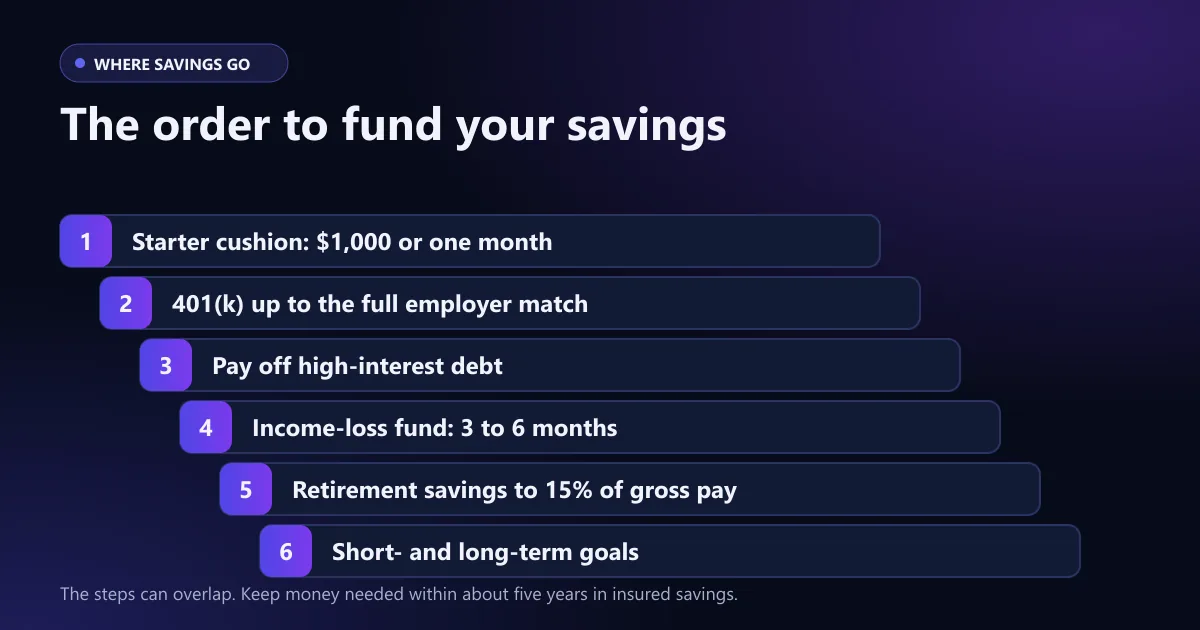
The steps can overlap, so you don't have to finish one before starting the next. Here's how the split might look in a few common situations:
| Your situation | How to split your savings |
|---|---|
| Credit card debt, no cushion | Build the starter cushion first, then send every spare dollar to the card while still contributing enough to get the 401(k) match |
| No debt, no cushion | Half to your income-loss fund, half to retirement |
| Cushion built, no debt | Three-quarters to retirement, one-quarter to other goals |
| Buying a home in about 3 years | Half to the down payment, half to retirement |
If the order sounds familiar, it's close to the flowchart many Reddit users point to on r/personalfinance: a small cushion, the employer match, high-interest debt, then a full emergency fund and retirement.
Where to Put Your Savings
The right account depends on when you'll need the money. Anything you might need soon should be safe and easy to reach, while money you won't touch for years can be invested.
| Goal | When you'll need it | Where to keep it |
|---|---|---|
| Income-loss fund | Any time | High-yield savings or money market account |
| Non-monthly expenses | Within a year | A separate savings account or savings "bucket" |
| Car, vacation, or wedding | 1 to 3 years | High-yield savings, CDs, or Treasury bills |
| Down payment | 2 to 5 years | High-yield savings, CDs, or Treasury bills |
| Kids' education | 5+ years | A 529 plan |
| Retirement | 20+ years | 401(k), Roth IRA, or Traditional IRA |
The same timeline answers the save-vs.-invest question. Money you'll need within about five years belongs in savings, where its value won't drop. Money for goals further out can be invested, since it has time to ride out market swings.
Okay, What Should I Save For?
A percentage is easier to stick with when you know what it's for. Most people save for three things: protection if their income stops, retirement, and the things they want in the next few years. Emergencies are a big one. In SoFi's April 2024 Banking Survey of 500 U.S. adults, 77% of people with a savings account said they use it to save for emergencies.
Emergency Fund? No, an Income-Loss Fund
Standard advice says to keep an emergency fund with three to six months' worth of expenses to cover a job loss, a medical emergency, or a home repair. The advice is sound. The label is the problem.
Most so-called emergencies are predictable. Cars break down, roofs wear out, and people get sick and owe a deductible. You can't know exactly when those bills will hit, but you know they will, so you can plan for them like any other expense.
Give each one its own savings job, such as a car repair fund, a medical fund, or a home maintenance fund. Homeowners often set aside 1% to 2% of their home's value each year for upkeep.
With those costs handled, your big fund has one job: replacing your paycheck if it stops. Think of it as a spare tire for your income. Sizing it takes two steps:
- Add up your bare-bones monthly living expenses: housing, utilities, groceries, insurance, transportation, and minimum debt payments.
- Multiply that total by the number of months it might take you to replace your income.
For a two-income household with steady jobs, three months may be enough. If you're single, self-employed, paid on commission, or working in a slow-hiring field, you may want to aim for six months or more. State unemployment benefits replace only part of your pay, and in most states they last 26 weeks or less.
Say your bare-bones costs are $3,000 a month and you want four months covered. That's a $12,000 fund, which you can build in about 18 months by saving $300 from each biweekly paycheck.
Retirement Savings
Most retirement guidelines call for saving 15% of your gross income, including any employer match. Fidelity uses that benchmark, and Dave Ramsey's company, Ramsey Solutions, sets the same 15% target once you've cleared all debt except the mortgage and built a full emergency fund.
Start with your employer's 401(k) match. If your company matches 50% of contributions up to 6% of pay, putting in 6% gets you another 3%. That's an instant 50% return, which makes matching contributions about the easiest raise you'll ever get.
After the match, choose the right accounts:
- 401(k): Contributions come straight out of your paycheck. Traditional contributions lower your taxable income now, and many plans offer a Roth option as well.
- Traditional IRA: Contributions may be tax-deductible, but you pay income tax when you withdraw the money in retirement.
- Roth IRA: You contribute money you've already paid tax on. In return, you get a tax-free withdrawal in retirement once you're 59½ and the account is at least five years old.
The IRS caps how much you can put into retirement funds each year. For 2026, the limits are $24,500 for a 401(k) and $7,500 for an IRA. Workers 50 and older can add catch-up contributions of $8,000 to a 401(k) ($11,250 at ages 60 to 63) and $1,100 to an IRA. See the IRS contribution limits page for details, and check for 2027 figures before you set next year's contribution.
To see how a traditional 401(k) contribution changes your take-home pay, add it under Advanced in our paycheck calculator. Because the contribution lowers your taxable wages, your paycheck usually drops by less than the amount you save.
With retirement, an early start beats a big one. Invest $200 a month from age 25 to 65 at a 7% average annual return, and compound interest grows it to about $525,000. Start at 35 instead, and you'd have about $244,000.
Those 10 extra years cost $24,000 in contributions and add about $281,000 to the final balance. Returns aren't guaranteed, but the pattern holds: the earliest dollars do much of the work.
If you're behind, save more than 15% and use catch-up contributions once you turn 50.
Short-Term and Long-Term Savings Goals
Short-term savings cover things you'll pay for within the next few years, like a car, a vacation, a wedding, or moving costs. Long-term financial goals sit further out: a down payment, a child's education, starting a business, or retiring early.
The math is the same for any goal. Divide the cost by the months until your deadline to get a monthly savings goal, then divide it by the number of paychecks in that window to see what to save from each paycheck:
| Goal | Cost | Deadline | Per month | Per biweekly paycheck |
|---|---|---|---|---|
| Down payment | $30,000 | 4 years | $625 | $288 |
| Used car | $8,000 | 2 years | $333 | $154 |
For a house, putting 20% down on a conventional loan lets you avoid private mortgage insurance, but you don't always need that much. Some conventional loans accept 3% down, and FHA loans accept 3.5% with a qualifying credit score. Whatever you put down, budget for closing costs too, which often run 2% to 5% of the loan amount.
For a car, a common guideline is to put 20% down, keep the loan to four years or less, and hold total car costs under 10% of your gross income.
It helps to give each goal its own savings account or bucket, named after the goal. A balance labeled "Kitchen remodel" is a lot harder to raid than one labeled "Savings."
Prioritizing Debt vs. Savings Goals
Whether to pay down debt or save usually comes down to the interest rate. According to the Federal Reserve, credit cards charged an average of 22.36% on balances that carried interest in August 2026. Paying off a card at 22% works like earning a guaranteed 22% return, and no savings account comes close.
Still, sending every dollar to debt and nothing to savings has a catch: the next flat tire goes right back on the card. That's why it makes sense to do both, in the order covered earlier: a starter cushion, the employer match, high-interest debt, and then the rest of your savings goals. Low-interest debt, like most mortgages and federal student loans, can stay on its regular payment schedule while you save and invest.
Focus on Non-Monthly Expenses First
Before you throw extra money at debt, plan for the bills that don't show up every month. Car insurance, registration, holidays, back-to-school shopping, annual subscriptions, and medical deductibles are easy to forget until they're due. When one catches you off guard, it tends to land on a credit card and undo your payoff progress.
The fix is to list each one, divide its yearly cost by 12, and save that amount every month:
| Expense | Yearly cost | Save each month |
|---|---|---|
| Car insurance | $1,200 | $100 |
| Holiday gifts | $900 | $75 |
| Car maintenance and registration | $720 | $60 |
| Annual subscriptions and memberships | $180 | $15 |
| Total | $3,000 | $250 |
That comes to about $115 from each biweekly paycheck. Once these costs have money waiting for them, your extra debt payments stick.
Which Debt Should I Prioritize First?
Keep making the minimum payment on every debt, then choose a method for your extra money:
- Debt avalanche method: Put extra money toward the debt with the highest interest rate. Once it's paid off, move to the next-highest rate. This approach saves the most in interest.
- Debt snowball method: Put extra money toward the smallest balance first, regardless of rate. The quick wins help keep you motivated, and it's the method Dave Ramsey teaches.
Say you owe $4,500 on a credit card at 27%, $600 on a store card at 19%, and $9,000 on a car loan at 7%. With the avalanche, you'd start on the $4,500 card. With the snowball, you'd clear the $600 store card first. Either way, the car loan comes last.
A useful rule of thumb: pay off debt charging more than about 8% before you invest beyond the employer match. Debt under about 5% can usually be paid on schedule while you save. For rates in between, splitting your extra money between debt and savings is a reasonable middle ground.
How to Save Money While Living Paycheck to Paycheck
When there's never anything left at the end of the month, saving whatever's left over doesn't work. Savings has to come out first, even if the amount is small. These steps can help:
- Start with $10 to $25 a paycheck. At this stage, building the habit matters more than the amount.
- Split your direct deposit. Most employers let you send a set amount straight to savings, or you can set up an automatic savings transfer from checking on payday.
- Track every dollar for one month. Cancel any subscriptions you forgot about, and call your insurance, phone, and internet providers to ask for a lower rate.
- Stop paying bank fees. Overdraft and ATM fees can eat up more than you're saving.
- Save windfalls, like tax refunds, bonuses, cash gifts, and rebates.
- Sell things you don't use.
- Work toward getting one paycheck ahead, so this month's bills are paid with last month's income.
- Check whether you qualify for the Earned Income Tax Credit, which can mean a sizable refund for lower-income workers.
- Look at your biggest costs. A roommate, a cheaper car, or a lower insurance premium frees up far more money than skipping coffee.
Even small amounts add up. Saving $25 from every biweekly paycheck gives you $650 by the end of the year, enough to cover a car repair without reaching for a credit card. Our guide to living paycheck to paycheck has more steps for breaking the cycle.
How Much Money to Save When 20% Is Not Realistic
If 20% is out of reach, save what you can now and raise it over time. A savings rate you can keep up will do more for you than a bigger one you end up abandoning.
- Start with 1% to 5% of each paycheck. On a $2,000 biweekly paycheck, 5% comes to $100, or $2,600 over a year.
- Get the full 401(k) match once you have a small cushion in place. Skipping it means leaving part of your pay on the table.
- Raise your rate by one percentage point every few months. If you start at 3% and add a point every six months, you'll reach 10% in three and a half years. Many 401(k) plans can make these increases for you automatically.
- Save half of every raise. This keeps lifestyle inflation in check, and you won't miss money you never got used to spending.
For some perspective, Americans saved 3.8% of their disposable income in September 2026, according to the Bureau of Economic Analysis. If you're saving 10% of your paycheck, you're well ahead of the national personal saving rate.
Where Should I Keep My Savings?
Keep your savings in a separate account from checking so you don't spend it by accident. For most people, that means a high-yield savings account, which pays a much higher annual percentage yield (APY) than a standard savings account.
The difference adds up. The FDIC's national average savings rate was 0.38% in October 2026, while many online banks pay 3% or more. On a $10,000 balance, that's roughly $38 a year in interest versus $300.
APY tells you what you'll earn over a year, including compound interest. Savings rates are variable and subject to change, so compare yours with what other banks pay every few months. Some banks offer temporary promotional rates for new customers; these end after a set period, so read the terms before you sign up.
Whichever bank you choose, make sure it's FDIC-insured, or NCUA-insured if it's a credit union. FDIC insurance covers up to $250,000 per depositor, per insured bank, for each account ownership category.
Depending on the goal, you have a few other options:
- Money market accounts: Rates similar to high-yield savings, often with check-writing.
- Certificates of deposit (CDs): A fixed rate for a set term, with a penalty if you withdraw early.
- Treasury bills: Short-term U.S. government debt, exempt from state and local income tax.
- Brokerage and retirement accounts: Better suited to goals five or more years away.
How to Figure Out How Much to Keep in Savings vs. Checking
Checking should hold enough to cover one month of bills and spending, plus a small buffer so you don't overdraw. Everything beyond that belongs in savings, where it can earn interest.
- Add up a typical month of bills and spending.
- Add a buffer, such as $500.
- Treat the total as your checking target, and move anything above it to savings.
So if you spend $3,200 a month, you'd keep about $3,700 in checking and sweep the rest into savings. Most checking accounts pay little or no interest, so extra cash sitting there earns almost nothing.
The Right Savings Plan for You
There's no single recommended savings rate that fits everyone. The right amount is the one you can keep up, and your situation is the best place to start:
| Your situation | Savings rate to aim for |
|---|---|
| In your 20s, living at home | 30% to 50% |
| Early career, renting | 15% to 20% |
| Paying off credit card debt | 5% to 10%, plus extra debt payments |
| Family in a high-cost area | 10% to 15%, including the 401(k) match |
| Behind on retirement in your 40s or 50s | 20% or more |
| Self-employed or irregular income | 25% to 30% for taxes, then 15% to 20% of what's left |
From there, build the plan one step at a time. Get clear on your take-home pay and your fixed expenses, fund your non-monthly expenses, and set up a starter cushion. Then grab the employer match, pay off high-interest debt, finish your income-loss fund, and work your retirement savings up to 15%.
Automate each step so the money moves on payday without you having to think about it, and revisit the plan every six months or whenever your pay changes. A plan you actually follow will do more for your financial wellness than a perfect ratio on paper.
Key Takeaways
- How much of your paycheck should you save? Most financial experts recommend saving 20% of your take-home pay, with 10% as a reasonable floor. The right amount for you depends on your income, your fixed expenses, your debt, and your goals.
- Treat the 50/30/20 rule as a starting point, not a verdict. Giving every dollar a job turns savings into specific goals.
- Fund your savings in order: a starter cushion, the 401(k) match, high-interest debt, a full income-loss fund, 15% for retirement savings, and other goals.
- Set aside money for non-monthly expenses first so they don't end up on a credit card.
- If you're living paycheck to paycheck, start with $10 to $25, automate it, and increase it every time you get a raise.
- Keep savings in an FDIC-insured high-yield savings account, with about one month of expenses in checking. APY is variable and subject to change, so check your rate now and then.
- Start early. Compound interest rewards an early start more than a big one.
Articles are general information for US employees and are not tax, legal or financial advice. Tax rules change; check the official IRS or state sources linked on our homepage.