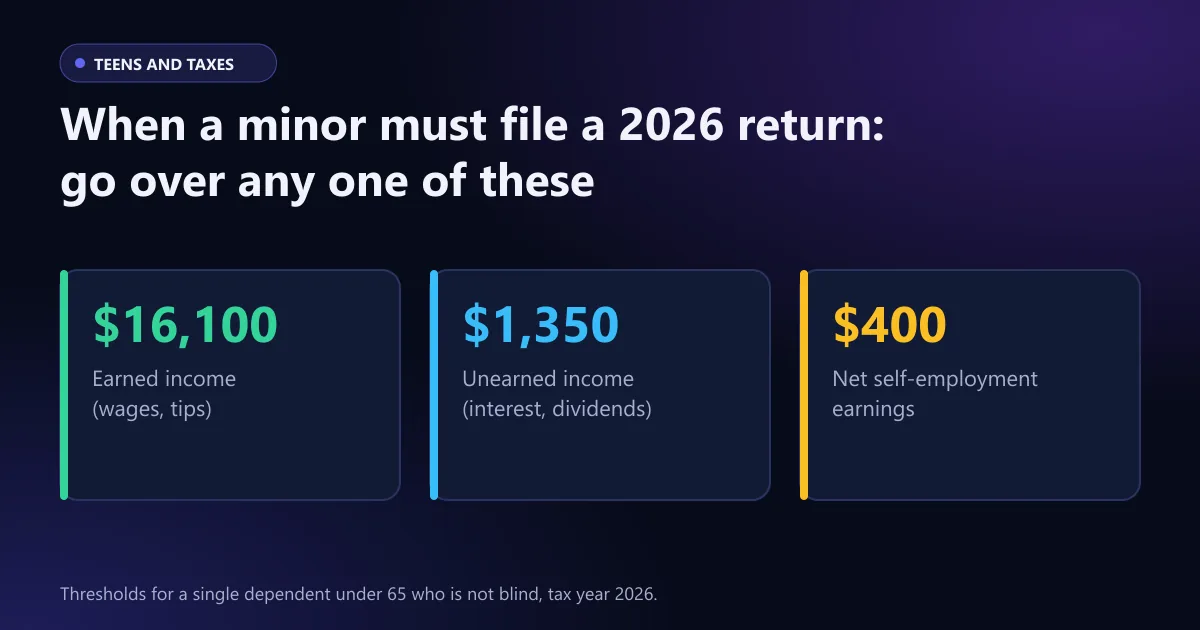
Yes, minors get taxes taken out of their paycheck. Employers withhold Social Security tax (6.2%) and Medicare tax (1.45%) from a minor's wages at every age, and withhold federal income tax based on the Form W-4 the minor submits. A minor claimed as a dependent has to file an income tax return for tax year 2026 when earned income exceeds $16,100, unearned income exceeds $1,350, or net self-employment earnings reach $400.
Paycheck withholding gives a teen worker 2 main benefits: each paycheck counts toward Social Security work credits, and over-withheld federal income tax returns as a refund once the minor files a tax return. Parents and teens use these rules for 3 tasks: reading a pay stub, completing Form W-4, and deciding whether to file a tax return. A minor's paycheck tax withholding has 4 parts: federal income tax, Social Security tax, Medicare tax, and state income tax.
Overview
A minor's income tax requirements depend on the type of income, not on the minor's age. The Internal Revenue Service (IRS) sets 5 dollar thresholds for a dependent child who is single, under 65, and not blind.
| Rule | Tax year 2025 | Tax year 2026 |
|---|---|---|
| Earned income filing threshold | $15,750 | $16,100 |
| Unearned income filing threshold | $1,350 | $1,350 |
| Net self-employment earnings threshold | $400 | $400 |
| Unearned income taxed at the parent's rate | Above $2,700 | Above $2,700 |
| Social Security and Medicare withholding on wages | 7.65% | 7.65% |
Earned income covers pay for work, including wages, salaries, tips, and net self-employment earnings. Unearned income covers investment returns, including interest, dividends, and capital gains.
New Tax Law Changes
The One Big Beautiful Bill Act (OBBBA), signed on July 4, 2025, made 4 tax law changes that affect working minors and their parents.
- Standard deduction: The single-filer standard deduction rose to $15,750 for 2025 and $16,100 for 2026, which raised the earned income filing threshold for dependents by the same amounts.
- Tip deduction: Workers deduct up to $25,000 of qualified tips from federal taxable income for tax years 2025 through 2028.
- Overtime deduction: Single filers deduct up to $12,500 of qualified overtime premium pay from federal taxable income for tax years 2025 through 2028.
- Child Tax Credit: Parents claim up to $2,200 per qualifying child, starting with tax year 2025.
The tip deduction and the overtime deduction lower federal income tax only. Employers still withhold Social Security tax and Medicare tax from a teen's tips and overtime pay.
Key Takeaways
- Employers withhold Social Security tax and Medicare tax from a minor's wages at every age.
- Dependents file a 2026 tax return when earned income exceeds $16,100.
- Unearned income above $1,350 creates a filing requirement for a dependent child.
- Net self-employment earnings of $400 or more trigger a tax return and 15.3% self-employment tax.
- Refunds of withheld federal income tax reach a minor only through a filed tax return.
How Do I Know if My Minor Child Has to File an Income Tax Return?
Your minor child has to file an income tax return when the child meets any 1 of 4 income tests for tax year 2026.
- Earned income exceeds $16,100.
- Unearned income exceeds $1,350.
- Gross income exceeds the larger of $1,350 or earned income (up to $15,650) plus $450.
- Net self-employment earnings reach $400 or more.
Age does not change the tests, so a 10-year-old and a 17-year-old follow the same thresholds. Gross income means the total of earned income and unearned income. IRS Publication 501 lists the full filing requirements for dependents.
At What Earned Income Does My Child Have to File Taxes?
Your child has to file taxes when earned income exceeds $16,100 for tax year 2026 ($15,750 for tax year 2025). The threshold equals the standard deduction for a single filer. A dependent's standard deduction equals earned income plus $450, with a floor of $1,350 and a cap of $16,100.
A teen who earns $9,000 at a summer job has a $9,450 standard deduction, $0 of taxable income, and no federal filing requirement.
How Does Unearned Income Impact a Minor's Income Tax Requirements?
Unearned income lowers a minor's filing threshold from $16,100 to $1,350. The IRS taxes a child's unearned income in 3 tiers for 2026.
| Unearned income | Tax treatment |
|---|---|
| First $1,350 | Tax-free |
| $1,351 to $2,700 | Taxed at the child's rate |
| Above $2,700 | Taxed at the parent's marginal rate on Form 8615 |
The third tier, known as the kiddie tax, applies to 3 groups: children under 18, 18-year-olds whose earned income covers half or less of their support, and full-time students aged 19 to 23 whose earned income covers half or less of their support.
Mixed income triggers a return sooner than wages alone. A teen with $3,000 of wages and $500 of bank interest has $3,500 of gross income, which exceeds the $3,450 limit (earned income plus $450), so the teen files a return and reports $50 of taxable income.
Does a Minor Have to Pay Social Security or Medicare Taxes?
Yes, a minor has to pay Social Security and Medicare taxes on wages. The employer withholds 6.2% for Social Security and 1.45% for Medicare, a combined 7.65% under the Federal Insurance Contributions Act (FICA), starting with the first dollar of pay. A $1,000 gross paycheck loses $76.50 to FICA at age 15, 17, or 45. Our FICA guide explains both taxes in detail.
Minor employee FICA taxes have 4 exceptions.
- Children under 18 who work for a parent's sole proprietorship, or for a partnership owned only by the child's parents, owe no FICA tax.
- Carriers under 18 who deliver newspapers owe no FICA tax.
- Students who work for the school, college, or university they attend owe no FICA tax on that job.
- Workers under 18 who do household work, including babysitting in a private home, owe no FICA tax when household work is not their main occupation.
Writing "Exempt" on Form W-4 stops federal income tax withholding only, and FICA withholding continues.
Does a Minor Have to Pay Self-Employment Taxes?
Yes, a minor has to pay self-employment taxes when net self-employment earnings reach $400 in a year. The self-employment tax rate is 15.3% (12.4% for Social Security plus 2.9% for Medicare), applied to 92.35% of net earnings. Self-employment covers work without an employer, including lawn mowing, babysitting for several families, tutoring, and online sales.
A teen who nets $2,000 from lawn mowing owes about $283 of self-employment tax ($2,000 × 92.35% × 15.3%). The standard deduction reduces income tax but does not reduce self-employment tax, so the teen files Form 1040 with Schedule C and Schedule SE and pays the $283 with $0 of income tax.
Should a Minor File a Return if Their Income Is Below the Filing Requirement?
Yes, a minor should file a return below the filing requirement when an employer withheld federal or state income tax from the minor's pay. A filed return is the only way to get that money back. Box 2 of Form W-2 shows the federal income tax withheld for the year.
A teen with $6,000 of wages and $240 of federal income tax withheld owes $0 of income tax and receives a $240 refund after filing. Social Security tax and Medicare tax are not refundable. The IRS pays a refund on a return filed within 3 years of the original deadline.
Can I Claim Unearned Income on My Child's Behalf?
Yes, you can report your child's unearned income on your own tax return with Form 8814, when your child meets all 6 conditions for tax year 2026.
- Age: The child is under 19 at year-end, or under 24 and a full-time student.
- Income type: The child's income comes only from interest and dividends, including capital gain distributions.
- Income amount: The child's gross income is more than $1,350 and less than $13,500.
- Payments: The child had no federal income tax withheld and made no estimated tax payments.
- Filing status: The child files no joint return.
- Filing requirement: The child would otherwise have to file a return.
A child with wages from a job fails condition 2, so a child with a paycheck files a separate return. Form 8814 adds the child's income above $2,700 to the parent's income, which can produce a higher tax bill than a separate return for the child.
Can My Child Still File a Tax Return if I Claim Them?
Yes, your child can still file a tax return when you claim the child as a dependent. The child checks the box on Form 1040 that says someone can claim the child as a dependent. The child's return does not cancel your dependent claim, and your claim does not block the child's refund.
Can I Handle IRS Correspondence on Behalf of My Child?
Yes, a parent or guardian can handle IRS correspondence on behalf of a minor child. A parent signs the return for a child who cannot sign, writing the child's name followed by "By (parent's signature), parent for minor child." The IRS treats a parent or guardian who signs the child's return as authorized to respond to notices and discuss that return.
A child who signs the return can check the Third Party Designee box on Form 1040 to let the IRS discuss the return with a parent.
Can My Minor Child Earn Income and Still Be a Dependent?
Yes, your minor child can earn income and still be a dependent. The qualifying child rules set no income limit. A minor child stays a dependent by meeting 5 tests.
- Relationship: The child is your son, daughter, stepchild, foster child, sibling, or a descendant of one of them.
- Age: The child is under 19 at year-end, or under 24 and a full-time student.
- Residency: The child lived with you for more than half of the year.
- Support: The child did not pay more than half of the child's own support.
- Joint return: The child files no joint return, except to claim a refund.
A paycheck affects only the support test. Wages a child saves do not count as support the child paid, so a teen who earns $12,000 and banks $9,000 stays a dependent in a household that spends $20,000 per year on the teen.
What if My Minor Child Has Gross Income Greater Than $13,850 in a Year?
No, a minor child with gross income greater than $13,850 does not need to file a tax return for tax year 2026, when all of the income is earned income of $16,100 or less. The $13,850 figure was the earned income threshold for tax year 2023, and the IRS raises the threshold each year.
| Tax year | Earned income threshold | Unearned income threshold |
|---|---|---|
| 2023 | $13,850 | $1,250 |
| 2024 | $14,600 | $1,300 |
| 2025 | $15,750 | $1,350 |
| 2026 | $16,100 | $1,350 |
A minor child with $14,000 of wages in 2026 has no filing requirement. A minor child with $14,000 of dividends in 2026 has to file, and $11,300 of that income (the amount above $2,700) is taxed at the parent's rate.
Do Minors Get Taxes Taken Out of Their Paycheck?
Yes, minors get taxes taken out of their paycheck. Payroll systems apply the same withholding rules to a 16-year-old and a 40-year-old, and a minor's pay stub shows up to 4 deductions between gross pay and net pay.
| Tax | Rate on a minor's wages | Set by |
|---|---|---|
| Social Security tax | 6.2% | Federal law, no age exemption |
| Medicare tax | 1.45% | Federal law, no age exemption |
| Federal income tax | $0 to 10% for most teen wages | Form W-4 and the IRS withholding tables |
| State income tax | 0% to about 5% for most teen wages | State of employment |
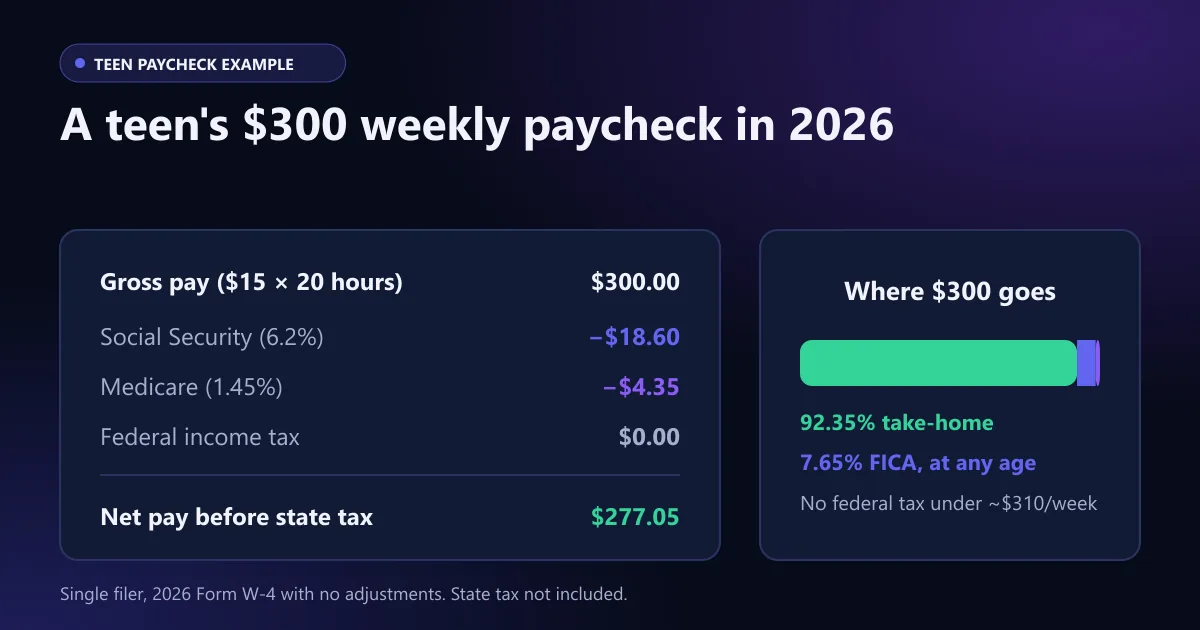
How much do minors get taxes taken out of their paycheck? Minors get 7.65% taken out for Social Security and Medicare, plus federal income tax once pay passes about $310 per week. A teen who earns $15 per hour for 20 hours has $300 of gross pay, $18.60 of Social Security tax, $4.35 of Medicare tax, $0 of federal income tax, and $277.05 of net pay before state tax. The 2026 withholding tables start federal income tax for a single filer once annualized pay passes $16,100. You can check a teen's numbers in our hourly paycheck calculator.
Do minors get less taxes taken out of their paycheck? No, minors pay the same rates as adults. Teen paycheck deductions are smaller in dollars for 1 reason: part-time pay sits below the standard deduction and inside the 10% tax bracket, which covers the first $12,400 of taxable income in 2026.
Why do minors get taxes taken out of their paycheck? Minors get taxes taken out for 2 reasons: FICA requires every employer to collect Social Security and Medicare tax on wages, and the IRS collects income tax through withholding during the year instead of 1 payment at filing time.
Do minors get federal taxes taken out of their paycheck with an exempt W-4? No, an employer withholds $0 of federal income tax from a minor who writes "Exempt" on Form W-4. A minor qualifies for exempt status by meeting 2 conditions: the minor owed no federal income tax last year and expects to owe none this year. A dependent with more than $450 of unearned income and more than $1,350 of total income cannot claim exempt status. Exempt status lasts 1 calendar year, and the minor submits a new Form W-4 by February 15 to keep the status.
Do the rules change by tax year? No, the 7.65% FICA rate applied to minors' paychecks in 2023, 2024, 2025, and 2026. Only the income tax thresholds changed.
State tax withholding for minors varies by state. Nine states withhold no state income tax from wages: Alaska, Florida, Nevada, New Hampshire, South Dakota, Tennessee, Texas, Washington, and Wyoming. See how every state taxes wages in our state-by-state guide.
| State | State taxes taken out of a minor's paycheck |
|---|---|
| Texas | No state income tax |
| Florida | No state income tax |
| California | State income tax based on Form DE 4, plus State Disability Insurance (SDI) |
| Ohio | No state income tax on the first $26,050 of annual income and 2.75% above that amount in 2026, plus city income tax in most cities |
| Michigan | Flat 4.25% state income tax after the personal exemption, plus city income tax in cities including Detroit and Grand Rapids |
Several Ohio cities, including Columbus, exempt workers under 18 from city income tax.
In Canada, employers deduct federal and provincial income tax and Employment Insurance (EI) premiums from a minor's paycheck. Canada Pension Plan (CPP) contributions start the month after the worker turns 18.
Looking for More Information?
The IRS publishes 4 free resources on minors' paycheck taxes and filing rules.
- Tax Withholding Estimator: Calculates the Form W-4 entries that match a teen's expected pay.
- Publication 501: Lists the filing requirement and standard deduction for dependents.
- Form 8615 instructions: Explain the tax on a child's unearned income above $2,700.
- Form 8814 instructions: Explain how a parent reports a child's interest and dividends.
Minors get taxes taken out of their paycheck at every age: 7.65% for Social Security tax and Medicare tax, plus federal income tax and state income tax based on Form W-4. A minor has to file an income tax return for tax year 2026 when earned income exceeds $16,100, unearned income exceeds $1,350, or net self-employment earnings reach $400, and a minor below those thresholds files a tax return to recover withheld income tax.
Articles are general information for US employees and are not tax, legal or financial advice. Tax rules change; check the official IRS or state sources linked on our homepage.