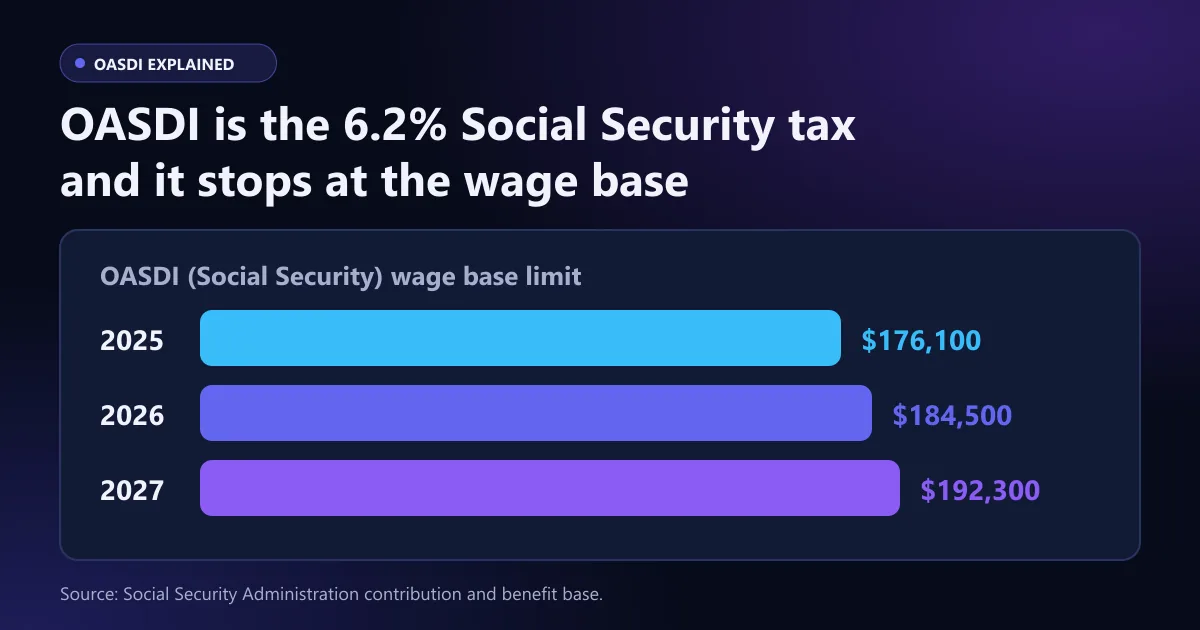
OASDI on a paycheck is the federal Social Security tax. The line stands for Old-Age, Survivors, and Disability Insurance (OASDI), and an employer withholds 6.2% of gross pay for OASDI on every paycheck until wages reach the annual OASDI tax limit, which is $176,100 for 2025 and $184,500 for 2026. The employer pays a matching 6.2%, and self-employed people pay the full 12.4%.
The OASDI paycheck deduction gives a worker 3 main benefits: work credits toward retirement benefits, insurance against long-term disability, and survivor benefits for the worker's family. The Social Security Administration (SSA) uses OASDI taxes for 1 purpose, which is paying monthly Social Security benefits to retirees, disabled workers, and survivors. The OASDI tax has 4 main parts: the tax rate, the wage base limit, the employee contribution, and the employer contribution.
This guide covers what OASDI stands for, why OASDI tax appears on a paycheck, how OASDI tax works, the OASDI limit for 2025 and 2026, the rules for self-employed people, the OASDI exemption rules, and the role of OASDI taxes in retirement planning.
Key Takeaways
- OASDI stands for Old-Age, Survivors, and Disability Insurance, the official name of the Social Security program.
- OASDI tax equals 6.2% of gross wages for employees, with a matching 6.2% from employers.
- OASDI tax stops at the wage base limit: $176,100 for 2025, $184,500 for 2026, and $192,300 for 2027.
- OASDI tax for self-employed people is 12.4% of net earnings, paid as part of self-employment tax.
- OASDI tax is mandatory for most U.S. workers, with exemptions for 5 narrow groups.
- OASDI tax and Social Security tax are the same tax under 2 names.
What Does OASDI Stand For?
OASDI stands for Old-Age, Survivors, and Disability Insurance, the legal name of the Social Security program in the United States (U.S.). The OASDI acronym names 3 types of insurance:
- Old-Age Insurance pays monthly retirement benefits to workers from age 62.
- Survivors Insurance pays monthly benefits to the spouse, children, and dependent parents of a worker who dies.
- Disability Insurance pays monthly benefits to workers with a medical condition that prevents work for 12 months or longer.
The OASDI line item has 6 common labels on a pay stub or earnings statement, including OASDI, Fed OASDI/EE, FICA OASDI, OASDI EE, SS Tax, and Social Security. All 6 labels mean the same deduction. The "EE" code means employee, so "Fed OASDI/EE" is the employee share of the federal OASDI tax, and "ER" marks the employer share.
A label with a state prefix, such as CA OASDI/EE in California or NJ OASDI EE in New Jersey, is still the federal OASDI tax at 6.2%. No state charges a separate OASDI tax. California State Disability Insurance (SDI) is a different deduction with a separate line on the pay stub.
What Is OASDI Tax?
OASDI tax is a federal payroll tax of 12.4% on earned income that funds Social Security benefits. An employee pays 6.2%, the employer pays 6.2%, and a self-employed person pays the full 12.4%.
The Federal Insurance Contributions Act (FICA) requires the OASDI payroll tax. FICA taxes have 2 parts: the OASDI tax at 6.2% and the Medicare tax at 1.45%, for a combined employee rate of 7.65%. Our FICA guide covers both parts in detail.
OASDI tax revenue goes into 2 trust funds. The Old-Age and Survivors Insurance Trust Fund receives 10.6 points of the 12.4% rate, and the Disability Insurance Trust Fund receives 1.8 points.
OASDI tax differs from federal income tax in 3 ways: the OASDI tax rate is flat, the OASDI tax has no deductions or filing statuses, and the OASDI tax stops at an annual wage limit.
Why Does OASDI Tax Appear on My Paycheck?
OASDI tax appears on your paycheck for 1 reason: federal law requires your employer to withhold 6.2% of your covered wages for Social Security. The employer withholds the OASDI tax before paying net pay, then sends the withholding and the employer match to the Internal Revenue Service (IRS).
A paycheck with $2,000 in gross pay shows an OASDI deduction of $124 (6.2%) and a Medicare tax deduction of $29 (1.45%).
The OASDI withholding on a pay stub does 3 things for the worker:
- Records earnings on the worker's Social Security record.
- Earns up to 4 work credits per year toward Social Security benefits.
- Raises the average earnings that the SSA uses to calculate the worker's monthly benefit.
OASDI taxable wages on a pay stub often differ from federal taxable wages. Traditional 401(k) contributions lower federal income tax wages but stay in OASDI taxable wages. Section 125 deductions, including health insurance premiums and Health Savings Account (HSA) payroll contributions, lower both. Form W-2 reports OASDI taxable wages in Box 3 and OASDI tax withheld in Box 4.
How Does OASDI Tax Work?
OASDI tax works by applying a flat 6.2% rate to each paycheck's OASDI taxable wages until year-to-date wages reach the annual wage base limit. OASDI withholding stops for the rest of the calendar year after wages pass the limit, and OASDI withholding restarts on January 1.
The OASDI payroll tax follows 5 steps:
- Calculate 6.2% of the employee's OASDI taxable wages for the pay period.
- Withhold the OASDI amount from the employee's gross pay.
- Match the withholding with an employer contribution of 6.2%.
- Deposit both contributions with the IRS.
- Report the year's OASDI wages and OASDI tax on Form W-2.
The SSA calls the OASDI limit the contribution and benefit base, and payroll providers call the same number the wage base limit or the taxable maximum. The SSA raises the wage base limit each year in line with the national average wage index. The same limit caps the earnings that count toward a worker's future Social Security benefits. Medicare tax has no wage limit.
OASDI Limit 2025
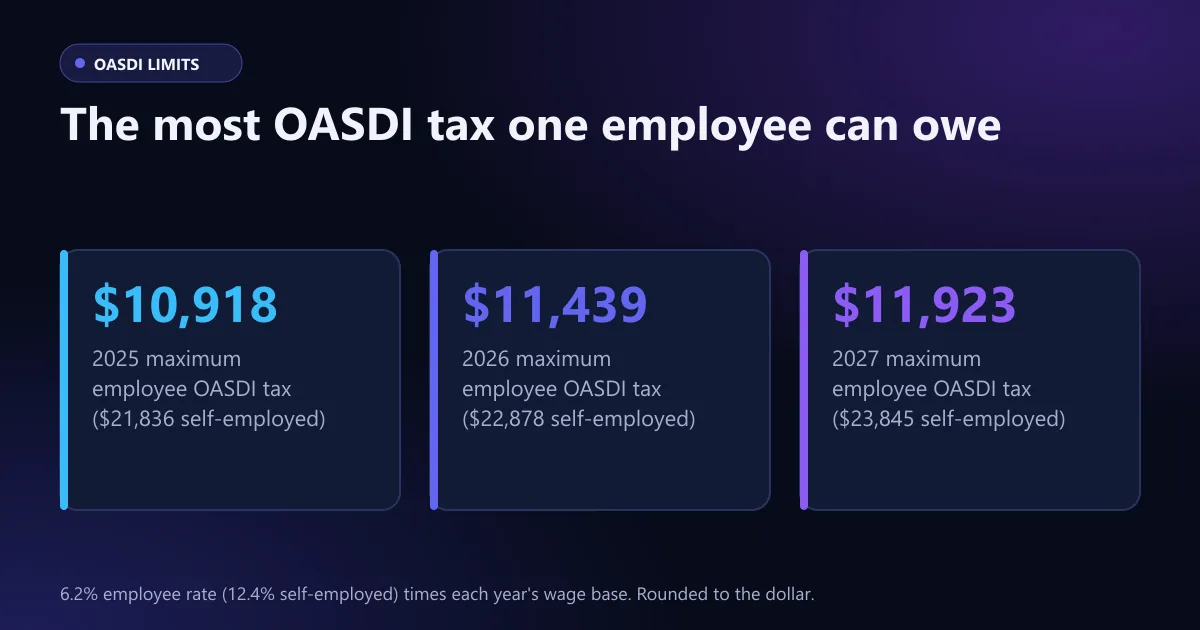
The OASDI limit for 2025 is $176,100. An employee who earned $176,100 or more in 2025 paid a maximum OASDI tax of $10,918.20, and the employer paid the same amount. A self-employed person paid a maximum of $21,836.40.
A worker with a $200,000 salary in 2025 paid OASDI tax on the first $176,100 and paid no OASDI tax on the remaining $23,900.
OASDI Limit 2026
The OASDI limit for 2026 is $184,500, an increase of $8,400 (4.8%) from 2025. The maximum OASDI tax for 2026 is $11,439.00 for an employee, $11,439.00 for the employer, and $22,878.00 for a self-employed person.
The SSA announced the next OASDI limit in October 2026: the wage base limit rises to $192,300 on January 1, 2027.
| Tax year | OASDI limit | Maximum employee OASDI tax (6.2%) | Maximum self-employed OASDI tax (12.4%) |
|---|---|---|---|
| 2025 | $176,100 | $10,918.20 | $21,836.40 |
| 2026 | $184,500 | $11,439.00 | $22,878.00 |
| 2027 | $192,300 | $11,922.60 | $23,845.20 |
Source: Social Security Administration, Contribution and Benefit Base.
OASDI Tax for Self-Employed People
OASDI tax for self-employed people is 12.4% of net self-employment earnings, since a self-employed person pays both the employee contribution and the employer contribution. The IRS collects the 12.4% as part of self-employment tax, which totals 15.3%: 12.4% for OASDI and 2.9% for Medicare.
Self-employed OASDI tax follows 4 rules:
- Threshold: self-employment tax applies to net earnings of $400 or more per year.
- Tax base: the 12.4% rate applies to 92.35% of net profit.
- Wage limit: the OASDI portion stops at the same wage base limit as employee wages, which is $184,500 for 2026, and W-2 wages count toward the limit first.
- Deduction: half of self-employment tax is deductible from income on Form 1040.
A freelancer with $80,000 in net profit has a tax base of $73,880 and owes $9,161.12 in OASDI tax plus $2,142.52 in Medicare tax, for a self-employment tax of $11,303.64. The freelancer deducts $5,651.82 from income.
Self-employed people calculate OASDI tax on Schedule SE during tax filing and pay through 4 quarterly estimated tax payments, since no employer withholds the tax.
Is OASDI Tax Mandatory?
Yes, OASDI tax is mandatory for most employees and self-employed people in the U.S. FICA requires employers to withhold OASDI tax from covered wages, and an employee has no form to stop the withholding. Form W-4 changes federal income tax withholding only and has no effect on the OASDI deduction.
Can I Be Exempt From OASDI Taxes?
Yes, you can be exempt from OASDI taxes, if you belong to 1 of 5 groups:
- Members of recognized religious groups that oppose insurance benefits, who file Form 4029, and ministers who file Form 4361.
- Nonresident aliens who work in the U.S. on F-1, J-1, M-1, or Q-1 visas.
- Students who work for the school, college, or university where the students are enrolled.
- State and local government employees who are covered by a qualifying public pension plan in place of Social Security.
- Children under age 18 who work for a parent's sole proprietorship.
An OASDI exemption removes Social Security coverage along with the tax. Exempt earnings add no work credits and do not count toward future Social Security benefits.
High earners are not exempt. A high earner pays OASDI tax on wages up to the wage base limit and pays no OASDI tax on wages above the limit.
Is Social Security Tax the Same as the OASDI Tax?
Yes, Social Security tax is the same as the OASDI tax. OASDI is the legal name of the program, and Social Security is the common name. Payroll systems print either name on a pay stub, and the IRS uses "Social Security tax" on Form W-2.
OASDI tax is not the same as FICA or Medicare tax. FICA is the law that covers both payroll taxes, and Medicare tax is the second FICA tax with a separate line on the paycheck.
| Payroll tax | Employee rate | Wage limit for 2026 |
|---|---|---|
| OASDI (Social Security) tax | 6.2% | $184,500 |
| Medicare tax | 1.45% | No limit |
| Additional Medicare tax | 0.9% | Applies to wages above $200,000 |
OASDI Taxes for Nonresident U.S. Citizens
Nonresident U.S. citizens pay OASDI taxes in 3 situations:
- Employment with an American employer abroad: the employer withholds 6.2% and pays the 6.2% match.
- Employment with a foreign affiliate of an American employer: OASDI tax applies, if the American employer has a Section 3121(l) agreement with the IRS.
- Self-employment abroad: the 12.4% OASDI tax applies to net earnings of $400 or more, and the foreign earned income exclusion does not reduce self-employment tax.
A U.S. citizen who works abroad for a foreign employer pays no OASDI tax on the foreign wages and usually pays into the host country's social security system.
The U.S. has totalization agreements with 30 countries, including Canada, the United Kingdom, Germany, and Japan. A totalization agreement assigns a worker's coverage to 1 country, which prevents Social Security tax in 2 countries on the same earnings. A certificate of coverage from the SSA or the foreign agency proves the exemption from the other country's tax.
Does the OASDI Tax Cover Retirement Expenses?
No, the OASDI tax does not cover all retirement expenses. Social Security retirement benefits replace about 40% of pre-retirement earnings for an average earner, and most retirees need 70% to 80% of pre-retirement income. The average retired worker received about $2,071 per month in January 2026.
OASDI taxes qualify a worker for retirement benefits under 4 rules:
- Work credits: a worker needs 40 credits, which takes 10 years of work, and earns 1 credit per $1,890 of covered earnings in 2026.
- Benefit formula: the SSA bases the monthly benefit on the worker's 35 highest-earning years.
- Claiming age: retirement benefits start as early as age 62, and the full retirement age is 67 for workers born in 1960 or later.
- Delayed claiming: the monthly benefit grows 8% per year between full retirement age and age 70.
Retirement planning fills the remaining gap with 3 other income sources, including a 401(k) plan, an individual retirement account (IRA), and personal savings. Our guide on how much of your paycheck to save covers retirement savings targets.
OASDI Tax Tips
There are 6 OASDI tax tips for employees and self-employed people:
- Check each pay stub: the OASDI deduction equals 6.2% of the OASDI taxable wages for the pay period.
- Compare Form W-2 Box 3 and Box 4: Box 4 equals 6.2% of Box 3, and Box 3 stays at or below the wage base limit.
- Review your earnings record in a my Social Security account once a year, and report missing wages to the SSA.
- Claim a credit for excess OASDI tax on your federal return, if you had 2 or more employers and combined wages above the OASDI limit.
- Set aside 15.3% of net self-employment income for quarterly estimated tax payments.
- Use tax help when filing taxes: tax preparers and most tax software apply the excess OASDI credit and the self-employment tax deduction for you.
OASDI taxes have no effect on a credit score, since credit bureaus do not track payroll taxes.
The Takeaway
OASDI on a paycheck is the federal Social Security tax. An employer withholds 6.2% of gross pay for Old-Age, Survivors, and Disability Insurance until wages reach the annual OASDI tax limit, which is $176,100 for 2025 and $184,500 for 2026, and the employer pays a matching 6.2%. Self-employed people pay the full 12.4%.
The OASDI paycheck deduction earns work credits toward retirement benefits, disability insurance, and survivor benefits. The 4 parts of the OASDI tax are the tax rate, the wage base limit, the employee contribution, and the employer contribution. OASDI tax is mandatory for most U.S. workers, and Social Security benefits replace about 40% of pre-retirement earnings, so retirement planning needs savings beyond OASDI taxes.
See your own OASDI line next to every other deduction in the free paycheck calculator.
FAQ
Why is OASDI taken out of my paycheck?
OASDI is taken out of your paycheck to fund Social Security benefits. FICA requires your employer to withhold 6.2% of your covered wages, and the withholding pays for retirement benefits, disability benefits, and survivor benefits.
Is it mandatory to pay OASDI tax?
Yes, it is mandatory to pay OASDI tax on covered wages and on net self-employment earnings of $400 or more. Only 5 narrow groups qualify for an OASDI exemption, including certain religious group members, nonresident aliens on student or exchange visas, and students employed by their own school.
Can I get OASDI tax back?
No, you cannot get correctly withheld OASDI tax back as a refund. You get OASDI tax back in 2 cases: combined withholding from 2 or more employers went above the annual maximum, or an employer withheld OASDI tax by mistake. Workers receive the value of OASDI taxes later as Social Security benefits.
What is the difference between OASDI and Social Security?
There is no difference between OASDI and Social Security. OASDI is the legal name of the program, and Social Security is the everyday name. The OASDI line and the Social Security line on a pay stub are the same 6.2% tax.
Can I opt out of OASDI tax?
No, you cannot opt out of OASDI tax as a regular employee or self-employed person. Only workers in an exempt group leave the system, and the exemption requires IRS approval through Form 4029 or Form 4361 for religious exemptions.
At what age is Social Security no longer taxed?
Social Security tax has no age limit. A worker pays OASDI tax on wages at any age, including after Social Security benefits start. Federal income tax on Social Security benefits has no age cutoff and depends on combined income: up to 50% of benefits are taxable above $25,000 for single filers and $32,000 for joint filers, and up to 85% are taxable above $34,000 and $44,000. Taxpayers age 65 and older claim an extra deduction of up to $6,000 for tax years 2025 through 2028, which lowers taxable income.
Can you get a refund if you overpay OASDI taxes?
Yes, you can get a refund if you overpay OASDI taxes. Claim the excess as a credit on Schedule 3 of Form 1040, if 2 or more employers withheld more than the annual maximum combined, which is $11,439.00 for 2026. Ask the employer for a refund, if a single employer withheld too much, and file Form 843 with the IRS, if the employer does not correct the error.
How do OASDI taxes impact your retirement planning?
OASDI taxes impact your retirement planning in 3 ways:
- Eligibility: OASDI taxes earn the 40 work credits required for retirement benefits.
- Benefit size: OASDI taxable wages from your 35 highest-earning years set your monthly benefit.
- Savings target: Social Security benefits replace about 40% of pre-retirement earnings, so the remaining income comes from a 401(k) plan, an IRA, and personal savings.
Articles are general information for US employees and are not tax, legal or financial advice. Tax rules change; check the official IRS or state sources linked on our homepage.