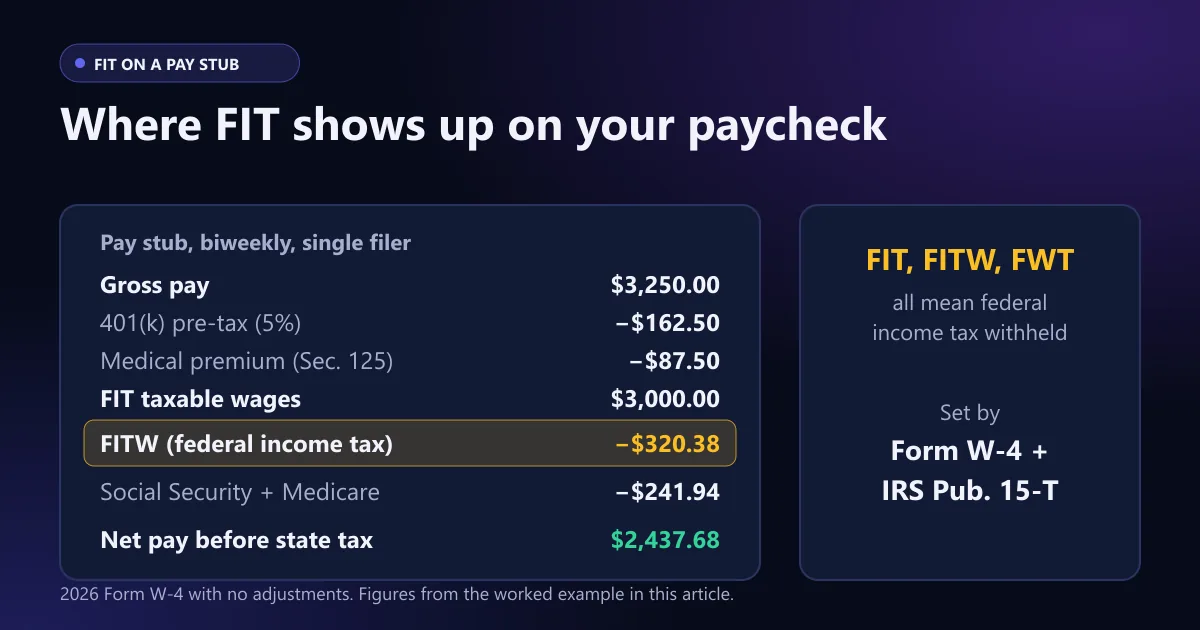
What is FIT on my paycheck? FIT on your paycheck is the federal income tax your employer withholds from your wages and sends to the Internal Revenue Service (IRS). Pay stubs label the line FIT, FITW (federal income tax withheld), or FWT (federal withholding tax). The FIT amount comes from 4 inputs: FIT taxable wages, pay frequency, filing status, and the entries on Form W-4.
Reading the FIT line correctly brings 3 benefits: fewer surprises at tax time, a dependable take-home pay number for budget planning, and early detection of payroll errors. Employees use the FIT figure to check withholding against the 2026 withholding tables, update Form W-4, plan for bonus and overtime pay, and estimate a tax refund or balance due before filing.
The FIT section of a pay stub has 4 parts: FIT taxable wages, FITW Current, FITW YTD, and ADDTL FITW when the employee requests extra withholding. This 2026 guide covers what FIT means on a pay stub, who pays FIT, how much federal income tax is, and how an employer calculates FIT. Later sections show how Form W-4 changes FITW, why FIT sometimes shows $0, and how FIT ties to Form W-2, refunds, bonuses, and retirement income.
Key Takeaways
- FIT stands for federal income tax, and FITW and FWT are other labels for the same withholding line on a pay stub.
- Employees pay FIT, and employers withhold it from each paycheck and deposit it with the IRS.
- FIT withholding in 2026 follows the IRS Publication 15-T tables, which build in the 2026 standard deduction and the 7 tax brackets from 10% to 37%.
- Form W-4 controls the FIT amount through filing status, the Step 2 checkbox, Step 3 credits, Step 4 adjustments, and the exempt checkbox.
- FIT taxable wages equal gross pay minus pre-tax deductions, such as traditional 401(k) contributions and Section 125 health premiums.
- Bonuses usually face a flat 22% FIT withholding rate, and supplemental wages above $1 million face 37%.
- Overtime pay still has FIT withheld in 2026, and the new overtime deduction (up to $12,500, or $25,000 for joint filers) is claimed on the tax return or built into the 2026 Form W-4.
- FITW YTD on the last pay stub of the year matches Box 2 of Form W-2.
FIT Withholding in 2026: Four Numbers That Drive the Paycheck Line
Four 2026 numbers drive the FIT line on most paychecks: the standard deduction, the bracket thresholds, the 22% bonus rate, and the $2,200 child credit on Form W-4.
| 2026 number | What it is | Effect on the FIT line |
|---|---|---|
| $16,100 / $32,200 / $24,150 | Standard deduction for single, married filing jointly, and head of household filers | Annual taxable wages up to this amount carry $0 FIT under standard withholding |
| 10% to 37% (7 brackets) | Federal tax rates; the 22% bracket starts at $50,400 of taxable income for single filers ($100,800 joint) | Sets the rate on each extra dollar of taxable wages |
| 22% | Optional flat withholding rate on supplemental wages such as bonuses (37% above $1 million) | Sets FIT on a separately paid bonus |
| $2,200 | Credit per qualifying child under 17 in Step 3 of the 2026 Form W-4 | Cuts annual FIT withholding by $2,200 per child, about $84.62 per biweekly paycheck |
Sources: IRS IR-2025-103, IRS Publication 15-T.
What Does FIT Mean on a Pay Stub?
FIT on a pay stub means federal income tax withheld from that paycheck and sent to the IRS. The FIT line is a prepayment of your yearly federal income tax, not an extra tax. Form 1040 credits every FIT dollar against the tax you owe for the year.
The FIT amount changes with 4 inputs: FIT taxable wages, pay frequency, filing status, and Form W-4 entries. Two employees with the same salary get different FIT lines when their W-4 forms or pre-tax deductions differ.
FIT vs FITW vs FWT: What Is the Difference?
FIT, FITW, and FWT have no difference in meaning: all 3 codes label the same federal income tax withholding. Each payroll system picks its own abbreviation.
| Pay stub code | Stands for |
|---|---|
| FIT | Federal income tax |
| FITW | Federal income tax withholding (or withheld) |
| FWT | Federal withholding tax |
| FED FIT, FED WH, FED TAX | Federal income tax withholding |
| Federal Income Tax | The same line, spelled out |
Payroll providers such as ADP, Gusto, Paychex, and QuickBooks Payroll use different wording for this line. The label changes between employers, and the tax behind it stays the same.
Where Is FIT or FITW Shown on Your Paycheck?
FIT or FITW shows up in the taxes section of the pay stub, often titled "Taxes" or "Statutory Deductions," next to Social Security, Medicare, and state income tax. Most stubs list FITW in 2 columns: Current (this paycheck) and YTD (year to date). Online pay portals show the same line under a taxes or deductions tab.
The sample stub below belongs to a single filer paid biweekly, with a 2026 Form W-4 and no extra W-4 entries.
| Pay stub line | Current | YTD (10 paychecks) |
|---|---|---|
| Gross pay | $3,250.00 | $32,500.00 |
| 401(k) pre-tax contribution (5%) | −$162.50 | −$1,625.00 |
| Medical premium (Section 125) | −$87.50 | −$875.00 |
| FIT taxable wages | $3,000.00 | $30,000.00 |
| FITW (federal income tax) | −$320.38 | −$3,203.80 |
| Social Security (OASDI) | −$196.08 | −$1,960.80 |
| Medicare | −$45.86 | −$458.60 |
| Net pay before state tax | $2,437.68 | $24,376.80 |
FIT taxable wages sit $250 below gross pay on this stub, since the 401(k) and medical deductions come out before federal income tax. Social Security and Medicare apply to $3,162.50, the gross pay minus the Section 125 premium only.
Other Federal Withholding Codes You May See
There are 6 other federal codes on pay stubs and payroll reports, including FICA, OASDI, and MED.
| Code | Meaning | 2026 rate |
|---|---|---|
| FICA | Social Security and Medicare combined | 7.65% of wages (employee share) |
| OASDI, SS, SOC SEC | Social Security (Old-Age, Survivors, and Disability Insurance) | 6.2% of wages up to $184,500 |
| MED, MEDI, MEDICARE | Medicare tax | 1.45% of all wages |
| ADDL MED | Additional Medicare tax | 0.9% of wages above $200,000 |
| ADDTL FITW, ADDL FIT | Extra federal income tax from Form W-4 Step 4(c) | Flat dollar amount the employee chooses |
| FUTA | Federal unemployment tax | Employer-paid 6.0% of the first $7,000 (usually 0.6% after the state credit), never deducted from pay |
Non-federal codes sit on the same stub: SIT or SWT (state income tax), SDI (state disability insurance), and LIT or LWT (local income tax). Our guides to FICA and OASDI explain those lines.
Who Pays FIT and Where Do FIT Deductions Go?
The employee pays FIT, and the employer withholds it from wages and deposits it with the IRS on the employee's behalf. FIT is the employee's own income tax, so employers add no matching FIT from company funds. Employers match Social Security and Medicare, not FIT.
Employers handle FIT in 4 steps:
- Withhold FIT from each paycheck using the employee's Form W-4 and IRS Publication 15-T.
- Deposit the withheld FIT, Social Security, and Medicare through the Electronic Federal Tax Payment System (EFTPS) on a monthly or semiweekly schedule.
- Report each quarter's totals on Form 941.
- Report each employee's yearly FIT taxable wages and FIT withheld on Form W-2.
Companies that hire through an employer of record (EOR) still have FIT withheld from employee paychecks. The EOR runs payroll as the legal employer, makes the deposits, and issues the Form W-2.
Independent contractors follow a different path. A contractor gives the client Form W-9 instead of Form W-4, receives pay with no FIT withheld, and pays FIT through quarterly estimated taxes. The client withholds 24% backup withholding only when the contractor's Form W-9 lacks a correct taxpayer identification number (TIN).
FIT deposits go to the U.S. Treasury and fund the general federal budget, not one specific program. Individual income taxes brought in $2.656 trillion of $5.235 trillion in total federal receipts in fiscal year 2025, about 51% of all federal revenue, according to the U.S. Treasury. Social Security and Medicare taxes go to their own trust funds instead.
How Much Is Federal Income Tax?
Federal income tax in 2026 is 10% to 37% of taxable income, charged in 7 brackets after the standard deduction or itemized deductions. A single filer with $100,000 of wages and no other income owes $13,170, an effective rate of 13.17% of gross pay. Three factors decide how much FIT comes out of a paycheck: IRS tax bracketing, filing status, and withholding allowances (or the Form W-4 entries that replaced them).
IRS Tax Bracketing
IRS tax bracketing is progressive: each rate applies only to the slice of taxable income inside its bracket. A raise that crosses into a higher bracket raises the tax only on the dollars above the threshold.
| Rate | Single | Married filing jointly | Head of household |
|---|---|---|---|
| 10% | $0 to $12,400 | $0 to $24,800 | $0 to $17,700 |
| 12% | $12,401 to $50,400 | $24,801 to $100,800 | $17,701 to $67,450 |
| 22% | $50,401 to $105,700 | $100,801 to $211,400 | $67,451 to $105,700 |
| 24% | $105,701 to $201,775 | $211,401 to $403,550 | $105,701 to $201,750 |
| 32% | $201,776 to $256,225 | $403,551 to $512,450 | $201,751 to $256,200 |
| 35% | $256,226 to $640,600 | $512,451 to $768,700 | $256,201 to $640,600 |
| 37% | Over $640,600 | Over $768,700 | Over $640,600 |
Source: IRS IR-2025-103. Married filing separately uses the single thresholds through the 32% bracket, and its 35% bracket ends at $384,350.
A single filer with $100,000 of wages has $83,900 of taxable income after the $16,100 standard deduction. The tax is $1,240 at 10%, $4,560 at 12%, and $7,370 at 22%, for $13,170 in total. That filer's marginal rate is 22%, and the effective rate is 13.17% of gross pay.
Filing Status
Filing status sets the standard deduction and the bracket widths used for both the tax return and paycheck withholding. The IRS recognizes 5 filing statuses: single, married filing jointly, married filing separately, head of household, and qualifying surviving spouse. Form W-4 Step 1(c) groups the 5 statuses into 3 withholding choices.
| Form W-4 Step 1(c) choice | Filing statuses covered | 2026 standard deduction |
|---|---|---|
| Single or Married filing separately | Single; married filing separately | $16,100 |
| Married filing jointly or Qualifying surviving spouse | Married filing jointly; qualifying surviving spouse | $32,200 |
| Head of household | Head of household | $24,150 |
Head of household applies only to unmarried taxpayers who pay more than half the cost of keeping up a home for a qualifying person, such as a child. Taxpayers age 65 or older add $2,050 (single or head of household) or $1,650 per spouse age 65 or older on a married return to the 2026 standard deduction. A separate senior deduction of up to $6,000 per person runs from 2025 through 2028 and phases out above $75,000 of modified adjusted gross income ($150,000 joint).
Withholding Allowances
Withholding allowances are the pre-2020 Form W-4 method for lowering FIT, and the IRS removed them from Form W-4 starting in 2020. Employees hired before 2020 who never filed a new Form W-4 still have allowances on file, and employers still honor them.
In 2026, each allowance on a 2019 or earlier Form W-4 removes $4,300 of annual wages from the withholding calculation (IRS Publication 15-T). For a single employee earning $3,000 every 2 weeks, each allowance cuts FITW by about $36.38 per paycheck in the 22% bracket.
| Allowances on a 2019 or earlier W-4 (single) | Annual wages used for withholding | Biweekly FITW on $3,000 |
|---|---|---|
| 0 | $78,000 | $393.15 |
| 1 | $73,700 | $356.77 |
| 2 | $69,400 | $320.38 |
Two allowances produce the same FITW as a 2026 Form W-4 with no adjustments. The 2020 and later Form W-4 replaced allowances with dollar entries: Step 3 credits and Step 4 adjustments. A new hire who turns in no Form W-4 has FIT withheld as a single filer with no adjustments.
How Does an Employer Calculate FIT?
An employer calculates FIT in 4 steps: annualize the employee's FIT taxable wages, subtract the Form W-4 worksheet adjustment, apply the IRS annual withholding schedule, and divide the result by the number of pay periods. The steps come from the percentage method in IRS Publication 15-T, which automated payroll systems use. Manual payroll systems read the same results off the wage bracket tables in the same publication.
2026 FITW Calculation Example: $3,000 Biweekly Taxable Wages
A single employee with $3,000 of biweekly taxable wages has $320.38 of FITW withheld from each 2026 paycheck. The example assumes a 2026 Form W-4 with "Single or Married filing separately" in Step 1(c) and no entries in Steps 2, 3, or 4.
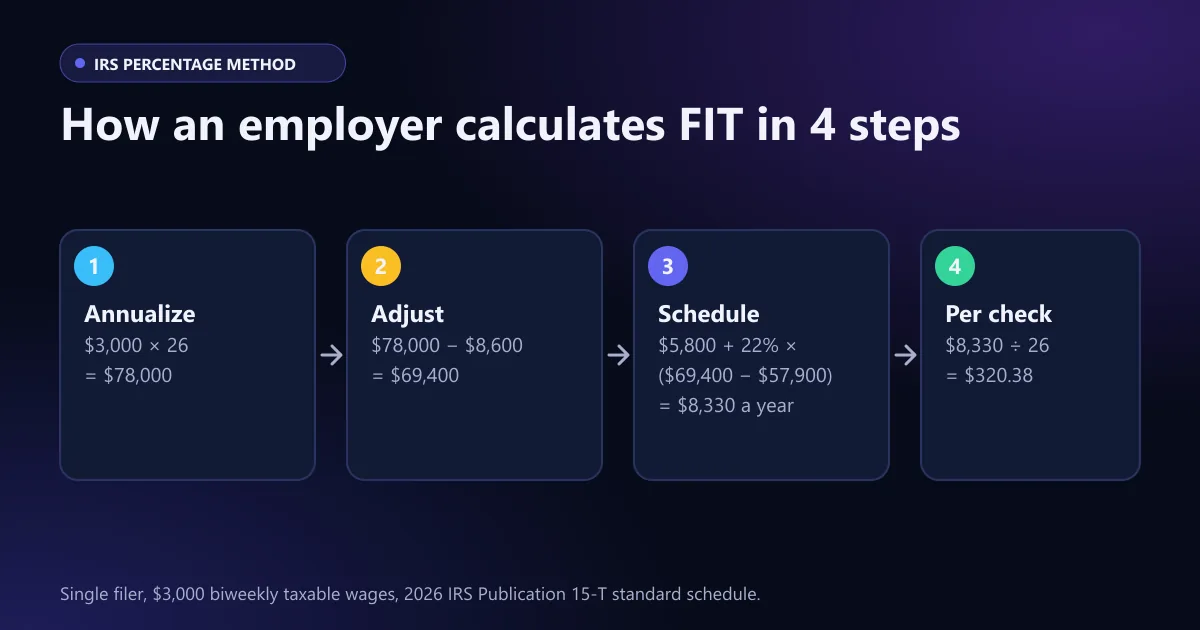
Step 1: Annualize the taxable wages. Multiply one pay period's FIT taxable wages by the number of pay periods in the year: $3,000 × 26 = $78,000. Payroll uses 52 periods for weekly pay, 26 for biweekly, 24 for semimonthly, and 12 for monthly.
Step 2: Apply the worksheet adjustment. Subtract $8,600 from the annual wages: $78,000 − $8,600 = $69,400. Line 1g of Worksheet 1A subtracts $8,600 for single and head of household employees and $12,900 for married filing jointly employees, as long as the Step 2 box is unchecked. The same worksheet adds any Step 4(a) other income and subtracts any Step 4(b) deductions, and the result is called the adjusted annual wage amount.
Step 3: Apply the withholding schedule. Find the row of the 2026 single schedule that holds $69,400 and run its formula: $5,800 + 22% × ($69,400 − $57,900) = $8,330 of annual withholding. The $57,900 to $113,200 row covers adjusted annual wages in the 22% range for single filers.
Step 4: Convert the result to one paycheck. Divide the annual withholding by the pay periods: $8,330 ÷ 26 = $320.38. The employer then subtracts any Step 3 credits per pay period and adds any Step 4(c) extra withholding. With neither entry, the FITW line shows $320.38, or $320 when the employer rounds to the nearest dollar. The $320.38 equals $694.17 per month in budget terms and $8,329.88 across 26 paychecks.
Worked Example: FIT on a $65,000 Salary in 2026
FIT on a $65,000 salary in 2026 is $5,620 a year for a single filer, or $216.15 per biweekly paycheck, with no pre-tax deductions and a 2026 Form W-4 with no adjustments. The withholding math runs $65,000 − $8,600 = $56,400, then $1,240 + 12% × ($56,400 − $19,900) = $5,620.
The 2026 tax return lands on the same $5,620. The $16,100 standard deduction leaves $48,900 of taxable income, and the 10% and 12% brackets produce $5,620 of tax, 8.65% of gross pay. You can reproduce the biweekly figure in our paycheck calculator.
| Filing status on Form W-4 | Annual FIT | Weekly | Biweekly | Semimonthly | Monthly | Share of gross pay |
|---|---|---|---|---|---|---|
| Single | $5,620 | $108.08 | $216.15 | $234.17 | $468.33 | 8.65% |
| Head of household | $4,548 | $87.46 | $174.92 | $189.50 | $379.00 | 7.00% |
| Married filing jointly (one earner) | $3,440 | $66.15 | $132.31 | $143.33 | $286.67 | 5.29% |
The married filing jointly row subtracts $12,900 on the worksheet and uses the married schedule, and the head of household row uses its own schedule with wider 10% and 12% ranges.
Why Do the 2026 Withholding Tables Mirror the Tax Brackets?
The 2026 withholding tables mirror the tax brackets by design: the IRS builds each table from the 2026 rate schedule and shifts every threshold by the part of the standard deduction that the worksheet adjustment leaves out. For single filers, the $16,100 standard deduction splits into the $8,600 worksheet adjustment and a $7,500 shift built into the table.
| Rate | 2026 tax bracket (single taxable income) | 2026 withholding table (single adjusted annual wages) | Withholding at the start of the row |
|---|---|---|---|
| 0% | Not a bracket | $0 to $7,500 | $0 |
| 10% | $0 to $12,400 | $7,500 to $19,900 | $0 |
| 12% | $12,400 to $50,400 | $19,900 to $57,900 | $1,240 |
| 22% | $50,400 to $105,700 | $57,900 to $113,200 | $5,800 |
| 24% | $105,700 to $201,775 | $113,200 to $209,275 | $17,966 |
| 32% | $201,775 to $256,225 | $209,275 to $263,725 | $41,024 |
| 35% | $256,225 to $640,600 | $263,725 to $648,100 | $58,448 |
| 37% | Over $640,600 | Over $648,100 | $192,979.25 |
Source: IRS Publication 15-T (2026), standard withholding rate schedule. The same split works for every filing status: married filing jointly uses $12,900 on the worksheet and $19,300 in the table ($32,200 total), and head of household uses $8,600 and $15,550 ($24,150 total).
The Step 2 checkbox tables skip the worksheet adjustment and use half the standard deduction and half-width brackets, so 2 jobs in one household share one standard deduction instead of claiming it twice. The result of this design is simple: a worker with one job, wage income only, and an accurate Form W-4 has FITW that matches the year's tax within a few dollars.
How to Calculate FIT Taxable Wages
To calculate FIT taxable wages, start with gross pay, add taxable fringe benefits, and subtract the pre-tax deductions that federal income tax excludes. The formula is FIT taxable wages = gross pay + taxable fringe benefits − pre-tax deductions. Taxable fringe benefits, such as gift card awards and personal use of a company car, add to the total.
There are 6 common pre-tax deductions that lower FIT taxable wages, including traditional 401(k) contributions and Section 125 health premiums.
| Payroll deduction | Lowers FIT taxable wages? | Lowers Social Security and Medicare wages? |
|---|---|---|
| Traditional 401(k), 403(b), or 457(b) contribution | Yes | No |
| Section 125 medical, dental, or vision premium | Yes | Yes |
| Health savings account (HSA) contribution through a cafeteria plan | Yes | Yes |
| Health flexible spending account (FSA), up to $3,400 in 2026 | Yes | Yes |
| Dependent care FSA | Yes | Yes |
| Commuter transit and parking benefits, up to $340 a month in 2026 | Yes | Yes |
| Roth 401(k) contribution | No | No |
| Union dues, garnishments, and after-tax insurance | No | No |
Source for the 2026 limits: IRS IR-2025-103.
FIT Taxable Wages vs FIT Withheld: What Is the Difference?
FIT taxable wages are the pay subject to federal income tax, and FIT withheld is the tax taken out of that pay. FIT taxable wages answer how much pay counts, and FIT withheld answers how much tax came out.
| Item | FIT taxable wages | FIT withheld (FITW) |
|---|---|---|
| What it measures | Pay subject to federal income tax | Federal income tax taken from that pay |
| How payroll gets it | Gross pay + taxable fringe benefits − pre-tax deductions | Publication 15-T schedule applied to FIT taxable wages and Form W-4 |
| Pay stub label | Federal taxable wages, FIT taxable wages | FIT, FITW, FWT |
| Form W-2 box | Box 1 | Box 2 |
| Example: $3,250 gross, single, biweekly | $3,000.00 | $320.38 |
Example: Same Gross Pay, Different Taxable Wages
Same gross pay produces different FIT when pre-tax deductions differ. Two single employees each earn $3,250 every 2 weeks, and both use a 2026 Form W-4 with no adjustments.
| Biweekly paycheck | Employee A | Employee B |
|---|---|---|
| Gross pay | $3,250.00 | $3,250.00 |
| 401(k) ($162.50) and Section 125 medical ($87.50) | $0.00 | $250.00 |
| FIT taxable wages | $3,250.00 | $3,000.00 |
| FITW | $375.38 | $320.38 |
| Social Security and Medicare | $248.63 | $241.94 |
| Net pay before state tax | $2,625.99 | $2,437.68 |
Employee B pays $55.00 less FIT per paycheck, or $1,430 a year. Employee B's $250 of pre-tax deductions lowers take-home pay by only $188.31, about 75 cents of net pay per dollar contributed. That gross-to-net gap is worth knowing for take-home pay budgeting before changing a 401(k) percentage.
Common Mistakes With FIT Taxable Wage Calculations
There are 3 common mistakes with FIT taxable wage calculations: misclassifying taxable wages, entering incorrect W-4 allowances or credits, and relying on old information.
Misclassifying taxable wages means counting pay as taxable or pre-tax when federal rules treat it the other way. There are 4 frequent misclassifications:
- Roth 401(k) contributions treated as pre-tax, when Roth deferrals stay inside FIT taxable wages.
- Traditional 401(k) contributions treated as exempt from Social Security and Medicare, when they lower FIT taxable wages only.
- Taxable fringe benefits, such as gift cards, left out of FIT taxable wages.
- Gross pay used in place of FIT taxable wages when checking whether FITW looks right.
Incorrect W-4 allowances produce FITW that runs too low or too high for the whole year. On a 2019 or earlier Form W-4, each extra allowance removes $4,300 of annual wages from withholding, about $946 of FIT a year in the 22% bracket.
On a 2020 or later Form W-4, the same error shows up as wrong Step 3 credit amounts, a skipped Step 2 for 2 jobs, or a filing status that no longer fits after marriage or divorce. Two jobs that each use standard withholding under-withhold: each payroll assumes $16,100 of tax-free pay, while the tax return allows $16,100 once.
Relying on old information produces wrong FIT checks, since the 2026 tables use different numbers than 2025. There are 4 figures that changed for 2026:
- Standard deduction: $16,100 for single filers in 2026, versus $15,000 built into the 2025 withholding tables.
- Child credit on Form W-4 Step 3: $2,200 per qualifying child in 2026, up from $2,000.
- Social Security wage base: $184,500 in 2026, up from $176,100.
- Form W-4 layout: the 2026 version adds an exempt checkbox and Deductions Worksheet lines for tips, overtime, car loan interest, and the senior deduction.
A paycheck calculator built on 2025 tables shows $337.46 of FITW on $3,000 of biweekly taxable wages for a single filer, $17.08 more than the 2026 figure of $320.38.
How Does Form W-4 Affect FITW in 2026?
Form W-4 affects FITW in 2026 through 7 entries: filing status, the Step 2 multiple-jobs setting, Step 3 credits, Step 4(a) other income, Step 4(b) deductions, Step 4(c) extra withholding, and the new exempt checkbox. The employer copies those entries into the Publication 15-T worksheet every payroll. Employees who leave Steps 2 through 4 blank get standard withholding for their filing status.
| 2026 Form W-4 entry | What the employee enters | Effect on FITW |
|---|---|---|
| Step 1(c) filing status | Single or married filing separately; married filing jointly; head of household | Picks the withholding schedule and the worksheet adjustment |
| Step 2 multiple jobs or spouse works | Checkbox, or extra tax from the Multiple Jobs Worksheet or IRS estimator | Raises FITW |
| Step 3 credits | $2,200 per qualifying child under 17 and $500 per other dependent, plus other expected credits | Lowers annual FITW dollar for dollar |
| Step 4(a) other income | Interest, dividends, retirement income, or other non-job income | Raises FITW |
| Step 4(b) deductions | Deductions Worksheet total, with new lines for qualified tips (up to $25,000), qualified overtime (up to $12,500, or $25,000 joint), car loan interest (up to $10,000), and the senior deduction ($6,000 per person 65 or older) | Lowers FITW |
| Step 4(c) extra withholding | A flat dollar amount per pay period | Raises FITW and shows as ADDTL FITW on some stubs |
| Exempt checkbox (new for 2026) | Certification of no 2025 tax liability and no expected 2026 tax liability | Sets FITW to $0 until February 16, 2027 |
Sources: IRS Publication 15-T, IRS Form W-4. An employee with 2 qualifying children who enters $4,400 in Step 3 has $169.23 less FITW per biweekly paycheck. A blank Step 4(b) tells payroll to assume only the basic standard deduction.
Can I Change My FITW Amount?
Yes, you can change your FITW amount at any time by giving your employer a new Form W-4. The employer puts the new form into effect no later than the start of the first payroll period ending on or after the 30th day after receiving it. Most payroll portals let employees submit the form online.
There are 4 steps to change FITW:
- Run the IRS Tax Withholding Estimator to size the change.
- Fill out a new 2026 Form W-4 with the updated Steps 2 through 4.
- Submit the form to payroll or through the payroll portal.
- Check the next 1 to 2 pay stubs for the new FITW amount.
Submit a fresh Form W-4 each January after a mid-year change. A mid-year estimator result spreads a full year's adjustment over fewer paychecks, so the same form over- or under-withholds once a new year starts. Our guide to why proper withholding matters covers when to update your W-4.
What Does ADDTL FITW Mean on a Pay Stub?
ADDTL FITW means additional federal income tax withholding: a flat dollar amount the employee asked the employer to withhold each pay period on top of the regular FIT calculation. The amount comes from Step 4(c) of Form W-4. Some payroll systems show ADDTL FITW on its own line, and others fold it into the FITW total.
There are 5 common reasons employees request additional withholding, including side income and Roth conversions:
- Freelance or side income that has no withholding
- Two jobs, or a working spouse, without a Step 2 adjustment
- Interest, dividend, or capital gain income
- Roth conversions and IRA withdrawals with no withholding
- Balances due on last year's tax return
Additional FITW Example
An employee who expects to owe $1,300 at tax time can enter $50 in Step 4(c) and cover the gap across 26 biweekly paychecks. The pay stub then shows the regular FITW plus the extra amount.
| Pay stub line | Current |
|---|---|
| FITW (table amount on $3,000 of taxable wages, single) | $320.38 |
| ADDTL FITW (Form W-4 Step 4(c)) | $50.00 |
| Total federal income tax withheld | $370.38 |
Starting the same change with 13 paychecks left in the year doubles the extra amount to $100 per paycheck. A $20,000 Roth conversion that stays inside the 22% bracket adds $4,400 of federal income tax, which works out to $440 of ADDTL FITW across the last 10 paychecks of the year. The IRS treats withholding as paid evenly through the year, so extra withholding added in the fall still counts toward every quarter's payment requirement.
Why Is FIT $0 or Different on Some Paychecks?
FIT is $0 or different on some paychecks for 6 main reasons: a change in pay, supplemental pay such as a bonus, a change in pre-tax deductions, a new Form W-4, a new calendar year's tables, and pay below the zero-withholding threshold. Payroll annualizes every paycheck as if it repeated all year. A $4,000 biweekly paycheck carries $540.38 of FITW for a single filer, $220 more than a $3,000 paycheck, and the tax return settles the exact amount owed.
Why Did My FITW Increase or Decrease?
FITW increases or decreases when FIT taxable wages, Form W-4 entries, or the IRS withholding tables change. A paycheck-to-paycheck change with no change in pay points to the Form W-4, pre-tax deductions, or a new tax year.
Why is my FITW high when my salary did not change? FITW runs high on an unchanged salary for 6 common reasons:
- Expired exemptions: an exempt Form W-4 lapses each February, and payroll then withholds as single with no adjustments.
- Ended pre-tax deductions: a 401(k) that hit its annual limit or a finished FSA election raises FIT taxable wages for the rest of the year.
- Added W-4 entries: a Step 2 checkbox, Step 4(a) other income, or Step 4(c) extra withholding raises FITW.
- Taxable fringe benefits: gift card awards or personal use of a company car add to FIT taxable wages.
- Extra pay in the period: a bonus, commission, retro pay, or holiday premium raises that paycheck's FITW.
- IRS lock-in letters: the IRS orders the employer to withhold at a set filing status and ignore the employee's Form W-4.
Why is my FITW lower than before? FITW drops for 5 common reasons, and the 2026 withholding tables are the most widespread one:
- 2026 tables: the $16,100 standard deduction built into the 2026 tables cut FITW on $3,000 of biweekly taxable wages from $337.46 under the 2025 tables to $320.38, a $17.08 drop per paycheck and $444 a year.
- New credits: a 2026 Form W-4 with $2,200 per qualifying child in Step 3 lowers FITW by $84.62 per child per biweekly paycheck.
- New deductions: Step 4(b) lines for qualified tips, overtime, car loan interest, and the senior deduction lower FIT taxable wages for withholding.
- Higher pre-tax deductions: a larger 401(k) percentage or new health premiums shrink FIT taxable wages.
- Lower pay: fewer hours, unpaid leave, or a smaller commission reduce FITW.
Why Is There No FITW Tax on My Paycheck?
There is no FITW tax on a paycheck for 5 main reasons: taxable wages below the withholding threshold, an exempt Form W-4, Step 3 credits that cover the full withholding, large Step 4(b) deductions, or pay as an independent contractor. Under standard withholding, FIT starts only once annualized taxable wages pass the standard deduction for the filing status.
| Pay frequency | Single or married filing separately | Head of household | Married filing jointly |
|---|---|---|---|
| Weekly | $309.62 | $464.42 | $619.23 |
| Biweekly | $619.23 | $928.85 | $1,238.46 |
| Semimonthly | $670.83 | $1,006.25 | $1,341.67 |
| Monthly | $1,341.67 | $2,012.50 | $2,683.33 |
| Annual | $16,100 | $24,150 | $32,200 |
The table shows the 2026 taxable wages per paycheck at or below which FITW is $0 with a 2026 Form W-4 and no Step 2 to 4 entries. Credits push the threshold far higher: a head of household parent with 3 qualifying children enters $6,600 in Step 3 and has $0 FITW on biweekly taxable wages up to $3,157.69. Independent contractors see no FITW at all, since a client paying on Form W-9 and Form 1099-NEC withholds nothing.
Who Can Claim Exemption From FITW in 2026?
Employees can claim exemption from FITW in 2026 only when 2 conditions are both true: no federal income tax liability in 2025 and no expected federal income tax liability in 2026.
No liability in 2025 means a $0 total tax on the 2025 Form 1040, or income below the filing requirement. A student whose only income is a part-time job paying less than the $16,100 standard deduction is the classic case. Our guide to when minors have to file taxes covers teen workers in detail.
To claim exemption, check the new "Exempt from withholding" box below Step 4(c) of the 2026 Form W-4 and complete Steps 1(a), 1(b), and 5. The exemption covers 2026 only. Employees keep it by submitting a new Form W-4 by February 16, 2027, and payroll withholds as single with no adjustments after that date when no new form arrives. Exempt status stops FIT only: Social Security and Medicare still come out of every paycheck.
Why Is FIT Still Withheld From Overtime Pay in 2026?
FIT is still withheld from overtime pay in 2026 since the "no tax on overtime" rule is a deduction on the tax return, not a payroll exclusion. From 2025 through 2028, workers deduct up to $12,500 of qualified overtime compensation ($25,000 on a joint return), and the deduction phases out above $150,000 of modified adjusted gross income ($300,000 joint).
Qualified overtime is only the "half" in time-and-a-half: the premium above the regular rate that the Fair Labor Standards Act (FLSA) requires. Social Security and Medicare still apply to all overtime pay. Starting with 2026 Forms W-2, employers report the qualified amount in Box 12 with code TT.
A single worker earning $30 an hour with 10 overtime hours every week earns $85,800 in 2026, including $7,800 of qualified premium (10 hours × $15 × 52 weeks). The deduction saves $1,716 of federal income tax in the 22% bracket. Entering $7,800 on the overtime line of the 2026 Form W-4 Deductions Worksheet moves that saving into paychecks, about $66 more per biweekly paycheck.
FIT Paycheck Troubleshooting: What Should You Check?
Check 5 items when FIT looks wrong: FIT taxable wages, pay frequency, Form W-4 filing status, Form W-4 Steps 2 through 4, and the FITW YTD pace. Each item feeds the Publication 15-T calculation, so one wrong input changes every paycheck.
How to Check Whether Your FITW Amount Makes Sense
To check whether your FITW amount makes sense, compare your FIT taxable wages with the 2026 quick-check table, or rerun the 4-step employer calculation on your own pay stub numbers. The table below works as a biweekly income FIT check for a single filer with a 2026 Form W-4 and no adjustments.
| Biweekly FIT taxable wages | Annual equivalent | Expected 2026 FITW per paycheck | FITW as a share of taxable wages |
|---|---|---|---|
| $1,000 | $26,000 | $38.08 | 3.81% |
| $2,000 | $52,000 | $156.15 | 7.81% |
| $3,000 | $78,000 | $320.38 | 10.68% |
| $4,000 | $104,000 | $540.38 | 13.51% |
| $5,000 | $130,000 | $766.69 | 15.33% |
A FITW figure far from the table points to a Form W-4 entry or a pre-tax deduction. The IRS Tax Withholding Estimator gives the most exact check for multiple jobs, side income, or credits.
FITW paycheck review checklist:
- Confirm the pay period dates and the pay frequency on the stub.
- Compare FIT taxable wages with gross pay minus pre-tax deductions.
- Match the filing status in the payroll portal to your 2026 Form W-4.
- Check the Step 3 credit and Step 4 amounts on file.
- Look for an ADDTL FITW line or extra withholding folded into FITW.
- Project the year: FITW YTD plus FITW Current times the paychecks left.
- Compare that projection with the total tax on last year's Form 1040.
What Should I Ask Payroll if My FITW Looks Wrong?
Ask payroll 5 questions when FITW looks wrong:
- Which Form W-4 version and filing status are on file for me?
- What amounts sit in my Step 2, Step 3, and Step 4 fields?
- Which deductions reduce my FIT taxable wages, and by how much?
- Was this paycheck's bonus or extra pay withheld at the 22% flat rate or with the aggregate method?
- Did an IRS lock-in letter or an expired exemption change my withholding?
Payroll fixes a withholding error by adjusting later paychecks in the same calendar year. After December 31, extra FIT comes back only through the tax return as part of the refund.
FITW Current vs FITW YTD: What Is the Difference?
FITW Current is the federal income tax withheld from the paycheck in hand, and FITW YTD is the running total withheld since January 1 of the same year. FITW YTD resets to $0 with the first paycheck dated in a new calendar year. The Current column drives one paycheck's take-home pay, and the YTD column drives the refund or balance due.
Current and YTD Example
A single employee with $3,000 of biweekly taxable wages has $320.38 of FITW Current on every 2026 paycheck, and FITW YTD grows by $320.38 each pay date.
| 2026 paycheck number | FITW Current | FITW YTD |
|---|---|---|
| 1 | $320.38 | $320.38 |
| 2 | $320.38 | $640.76 |
| 10 | $320.38 | $3,203.80 |
| 26 | $320.38 | $8,329.88 |
The final YTD figure of $8,329.88 sits $0.12 below the $8,330 annual calculation, a gap from rounding each paycheck to the cent. FITW YTD follows the pay date, not the work date: a paycheck for late-December work paid on January 1, 2027 counts toward 2027 FITW YTD.
Where Does FITW Appear on Form W-2?
FITW appears in Box 2 of Form W-2, labeled "Federal income tax withheld." Box 2 equals FITW YTD on the last pay stub of the year, unless payroll made a year-end correction. Box 1 shows the year's FIT taxable wages.
| Form W-2 box | What it shows | Matching pay stub line |
|---|---|---|
| Box 1 | Wages, tips, other compensation | FIT taxable wages YTD |
| Box 2 | Federal income tax withheld | FITW YTD, including ADDTL FITW |
| Box 3 and Box 4 | Social Security wages and tax | Social Security YTD |
| Box 5 and Box 6 | Medicare wages and tax | Medicare YTD |
| Box 12, code D | Traditional 401(k) deferrals | 401(k) YTD |
| Box 12, code TT (new for 2026) | Qualified overtime compensation | Overtime premium YTD |
| Box 16 and Box 17 | State wages and state income tax (SIT) | SIT YTD |
Box 1 runs lower than Box 3 and Box 5 for employees with traditional 401(k) deferrals, since those deferrals lower FIT wages only. Employers must furnish 2026 Forms W-2 by February 1, 2027.
FITW vs FICA, Social Security, Medicare, and SIT
FITW differs from FICA, Social Security, Medicare, and SIT in what each tax funds, how each rate works, and whether a tax return settles the amount. FITW prepays federal income tax and gets reconciled on Form 1040. FICA (Federal Insurance Contributions Act tax) is the combined Social Security and Medicare payroll tax, and SIT is state income tax withholding.
| Tax | Pay stub codes | 2026 employee rate | 2026 wage cap | Employer match | Settled on a tax return? | Form W-2 boxes |
|---|---|---|---|---|---|---|
| FITW | FIT, FITW, FWT | 10% to 37% through the withholding tables | None | No | Yes, on Form 1040 | Box 1 and Box 2 |
| Social Security | OASDI, SS | 6.2% | $184,500 (maximum tax $11,439) | Yes, 6.2% | Only excess withheld by 2 or more employers | Box 3 and Box 4 |
| Medicare | MED, MEDI | 1.45%, plus 0.9% on wages above $200,000 | None | Yes, 1.45% (no match on the 0.9%) | Only the additional 0.9% tax | Box 5 and Box 6 |
| FICA | FICA | 7.65% (Social Security + Medicare) | Social Security part only | Yes, 7.65% | Same as its 2 parts | Box 4 and Box 6 |
| SIT | SIT, SWT | $0 in 9 states, state rates elsewhere | Set by each state | No | Yes, on the state return | Box 16 and Box 17 |
Source for the wage base: SSA contribution and benefit base. The 9 states with no tax on wages are Alaska, Florida, Nevada, New Hampshire, South Dakota, Tennessee, Texas, Washington, and Wyoming, so employees in those states see no SIT line. See how every state taxes wages in our state-by-state guide.
Form W-4 controls FIT only. Social Security and Medicare ignore Form W-4 and come out at flat rates on every dollar of covered wages: on a $3,250 biweekly paycheck with a $87.50 Section 125 premium, FITW is $320.38 and FICA is $241.94.
How Does FIT Connect to a Refund or a Balance Due?
FIT connects to a refund or a balance due through Form 1040, which compares the year's FIT withheld, estimated payments, and refundable credits with the year's total tax. Payments above the total tax come back as a tax refund, and payments below it become a balance due. The formula is refund or balance due = (FITW YTD + estimated tax payments + refundable credits) − total tax.
| 2026 scenario (single filer) | Total tax | FIT withheld | Result |
|---|---|---|---|
| $65,000 salary, no other income, accurate Form W-4 | $5,620 | $5,620 | $0 refund and $0 balance due |
| Same salary plus $4,000 of interest income | $6,350 | $5,620 | $730 balance due |
| Same salary plus $50 of ADDTL FITW per biweekly paycheck | $5,620 | $6,920 | $1,300 tax refund |
There are 3 ways to stay clear of the IRS underpayment penalty on a balance due: owe less than $1,000 after withholding and credits, prepay at least 90% of the 2026 tax, or prepay at least 100% of the 2025 tax (110% when 2025 adjusted gross income topped $150,000). The $730 balance due in the table falls under the $1,000 line, so no penalty applies.
A large refund means the money sat with the U.S. Treasury all year without earning interest for you. Every $1,300 of over-withholding equals $50 of take-home pay per biweekly paycheck, money a monthly budget can put toward savings goals or debt payments. The 2025 withholding tables built in a $15,000 standard deduction, while the final 2025 standard deduction rose to $15,750, so most 2025 paychecks withheld slightly more than the final 2025 tax required.
How Is FIT Withheld on a Bonus?
FIT is withheld on a bonus in 1 of 2 ways: a flat 22% rate, or the aggregate method, which adds the bonus to regular wages and runs the normal withholding tables. Supplemental wages above $1 million in a calendar year face mandatory 37% withholding on the excess. Bonuses, commissions, severance pay, back pay, and award payments all count as supplemental wages.
The 22% flat rate is open to employers that pay the bonus separately or list it separately from regular wages, as long as FIT was withheld from the employee's regular wages this year or last year. The aggregate method combines the bonus with that period's regular pay, withholds on the total, and subtracts the FIT already withheld from regular pay.
| $5,000 bonus, single employee with $3,000 of biweekly taxable wages | Flat 22% method | Aggregate method |
|---|---|---|
| FIT on the bonus | $1,100.00 | $1,166.31 |
| Social Security (6.2%) | $310.00 | $310.00 |
| Medicare (1.45%) | $72.50 | $72.50 |
| Bonus net pay before state tax | $3,517.50 | $3,451.19 |
The aggregate figure comes from $8,000 of combined pay for the period, which carries $1,486.69 of FITW, minus the $320.38 of regular FITW: $1,166.31, or 23.3% of the bonus. The actual tax on this bonus is $1,100, since the extra $5,000 stays inside the 22% bracket for a single filer earning $78,000. Bonus withholding is a prepayment, and the tax return settles any difference.
Does FIT Still Apply in Retirement?
Yes, FIT still applies in retirement: pensions, annuities, traditional 401(k) and IRA withdrawals, and up to 85% of Social Security benefits count as taxable income. Retirees have no employer Form W-4, so each income source uses its own withholding form and default rate.
| Retirement income | Withholding form | Default FIT withholding |
|---|---|---|
| Pension or annuity paid in installments | Form W-4P | Single with no adjustments when no Form W-4P is on file; the 2026 Form W-4P adds a checkbox to elect no withholding |
| IRA withdrawal or required minimum distribution (RMD) | Form W-4R | 10%, adjustable from 0% to 100% |
| 401(k) payout eligible for rollover, paid to you | Form W-4R | 20% mandatory; a direct rollover skips it |
| Social Security benefits | Form W-4V | None, unless the retiree elects 7%, 10%, 12%, or 22% |
| Qualified Roth IRA withdrawal | None | None; the withdrawal is tax-free |
Source for Forms W-4P and W-4R: IRS Publication 15-T (2026). RMDs start at age 73, or 75 for anyone born in 1960 or later. Retirees age 65 or older add the $6,000 senior deduction for 2025 through 2028, and the 2026 Form W-4P accounts for it.
Withholding from an IRA distribution counts as paid evenly through the year. A retiree can take a December IRA withdrawal with heavy withholding and cover a full year of tax without quarterly estimated payments.
Frequently Asked Questions
What Is the Minimum Federal Tax Withholding?
The minimum federal tax withholding on wages is $0: no fixed minimum percentage applies, and FITW follows Form W-4 and the IRS tables. Wages below the standard deduction ($16,100 a year for a single filer) and an exempt Form W-4 both produce $0 FITW. Retirement payouts carry set rates: 20% mandatory on 401(k) payouts eligible for rollover, a 10% default on IRA withdrawals, and a 7% lowest option on Social Security through Form W-4V.
To prevent an underpayment penalty, withholding plus estimated payments must reach the smaller of 90% of the 2026 tax or 100% of the 2025 tax (110% above $150,000 of 2025 adjusted gross income). A balance due under $1,000 carries no penalty.
Is the Taxable Wage Base for FIT the Same for State and Local Taxes?
No, the taxable wage base for FIT is not always the same for state and local taxes. Most states start from federal wages, and 3 well-known exceptions change the number:
- Pennsylvania taxes employee 401(k) contributions for state income tax, so Pennsylvania wages run higher than FIT taxable wages.
- California and New Jersey tax health savings account (HSA) contributions, so wages in those states include HSA payroll deductions.
- Local wage taxes, such as the Philadelphia wage tax, use their own definitions of taxable pay.
Social Security uses a different base too: $184,500 of wages in 2026, while FIT has no wage cap.
How Do Self-Employed Individuals Pay FIT?
Self-employed individuals pay FIT through quarterly estimated tax payments on Form 1040-ES, since no employer withholds tax from their income. The 2026 due dates are April 15, 2026; June 15, 2026; September 15, 2026; and January 15, 2027. Payments go through IRS Direct Pay, the Electronic Federal Tax Payment System (EFTPS), or an IRS online account.
Self-employment tax adds 15.3% (12.4% Social Security and 2.9% Medicare) on 92.35% of net earnings, on top of FIT. Contractors give clients Form W-9 instead of Form W-4, and no FIT comes out of their payments. Workers with a W-2 job and a side business can skip estimates by raising FITW at the job through Step 4(a) or Step 4(c) of Form W-4.
What's the Difference Between Payroll Taxes and FIT?
The difference between payroll taxes and FIT is scope: payroll taxes fund Social Security, Medicare, and unemployment programs from wages alone, while FIT is the income tax on all taxable income, withheld from wages as a prepayment. There are 4 main differences:
- Employers match Social Security and Medicare and pay federal unemployment tax (FUTA) themselves, and employers add nothing to FIT.
- Payroll taxes use flat rates (7.65% employee FICA), while FIT runs through 7 brackets from 10% to 37%.
- Form W-4 changes FIT and leaves payroll taxes untouched.
- FIT gets reconciled on Form 1040 every year, while FICA is generally final once withheld.
How Do You Pay Taxes on Roth Conversions?
To pay taxes on Roth conversions, use 1 of 4 methods: raise paycheck withholding, make an estimated tax payment, withhold from a separate IRA distribution, or withhold from the conversion itself. A Roth conversion counts as ordinary income in the year of conversion, and the converted amount stacks on top of wages in the tax brackets. A $50,000 conversion that stays inside the 22% bracket adds $11,000 of federal income tax.
| Method | How it works | Main trade-off |
|---|---|---|
| Raise FITW at work | Enter extra withholding in Form W-4 Step 4(c) | Counts as paid evenly through the year, which helps prevent underpayment penalties |
| Estimated tax payment | Pay through Form 1040-ES in the quarter of the conversion | Credited on the date paid |
| Withhold from a separate IRA distribution | Elect withholding on Form W-4R | Counts as paid evenly through the year, and the distribution itself is taxable |
| Withhold from the conversion | Elect withholding on the converted amount | Shrinks the Roth balance, and the withheld part faces a 10% penalty before age 59½ |
Paying the tax from outside cash keeps the full converted amount growing tax-free in the Roth. A large conversion raises modified adjusted gross income, which can raise Medicare premiums (IRMAA) 2 years later.
Articles are general information for US employees and are not tax, legal or financial advice. Tax rules change; check the official IRS or state sources linked on our homepage.