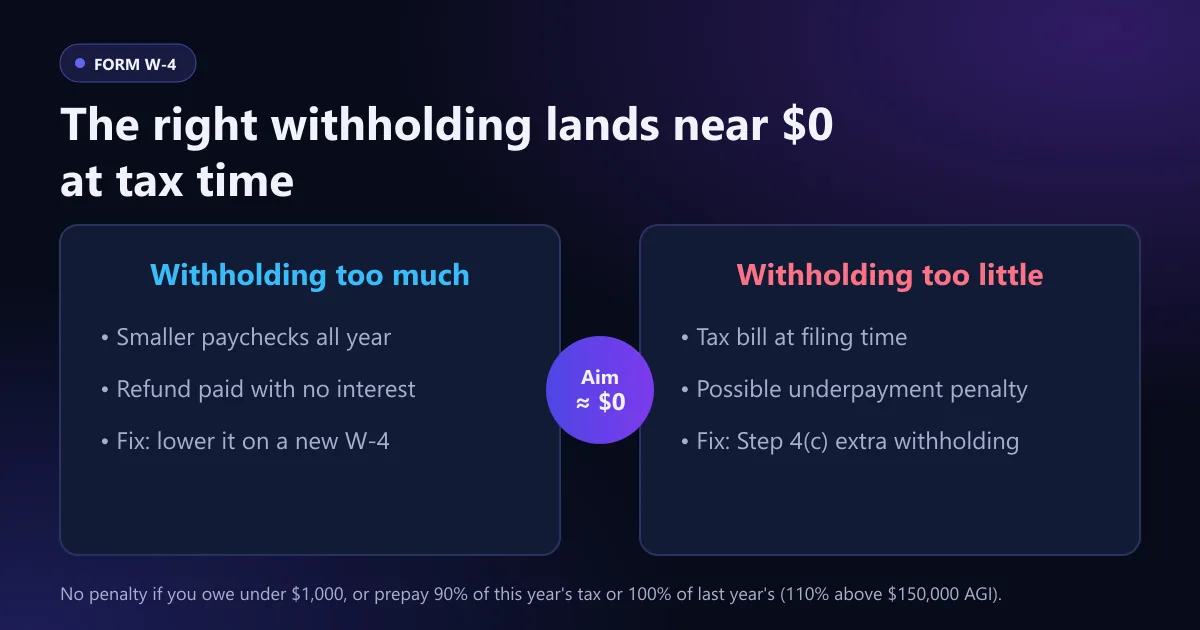
Having the proper amount of taxes withheld from your paycheck is important for 3 reasons: correct tax withholding keeps you clear of an Internal Revenue Service (IRS) underpayment penalty, prevents a large tax bill in April, and keeps your own money in your take-home pay instead of in an interest-free loan to the government.
Tax withholding is the federal income tax, state income tax, Social Security tax, and Medicare tax your employer takes out of gross pay each payroll period and sends to the government for you. Form W-4 controls the federal income tax part. This guide covers what a W-4 is, what happens when too much or not enough money is withheld, the new tax law changes on the 2026 form, the 5 reasons to adjust your W-4 withholding, the steps to adjust it, and the free tools that help you get the number right.
Overview
Proper tax withholding means the total withheld from your paychecks over the year lands close to your actual tax liability on Form 1040. The United States runs a pay-as-you-earn (PAYE) system, so the IRS expects tax payments during the year, not in one lump sum at filing time.
Paycheck tax withholding has 4 main parts:
- Federal income tax withholding, set by your Form W-4, your filing status, and your taxable wages.
- State income tax withholding and local tax withholding, set by a state form in most states. 9 states withhold no state income tax on wages, including Texas, Florida, and Washington.
- Social Security withholding, a flat 6.2% of wages up to the annual wage base.
- Medicare withholding, a flat 1.45% of all wages.
Social Security and Medicare together form Federal Insurance Contributions Act (FICA) withholding, and a W-4 does not change FICA. A W-4 changes only federal income tax withholding, which is the part that produces a tax refund or a tax bill. See our FICA guide for the payroll tax side.
Key Takeaways
- Withholding too little leads to a tax bill at filing and an underpayment penalty, if the balance due is $1,000 or more and no withholding safe harbor applies.
- Withholding too much leads to a tax refund, which is your own pay returned months late with no interest. A $2,500 refund equals about $208 per month, or about $96 per biweekly paycheck, missing from your net income all year.
- Form W-4 has no withholding allowances since the 2020 redesign. The form uses filing status, multiple-job information, dependent credits, other income, deductions, and extra withholding in dollars.
- The 2026 Form W-4 adds deduction lines for qualified tips, qualified overtime, car loan interest, and the senior deduction from the One Big Beautiful Bill Act (OBBBA).
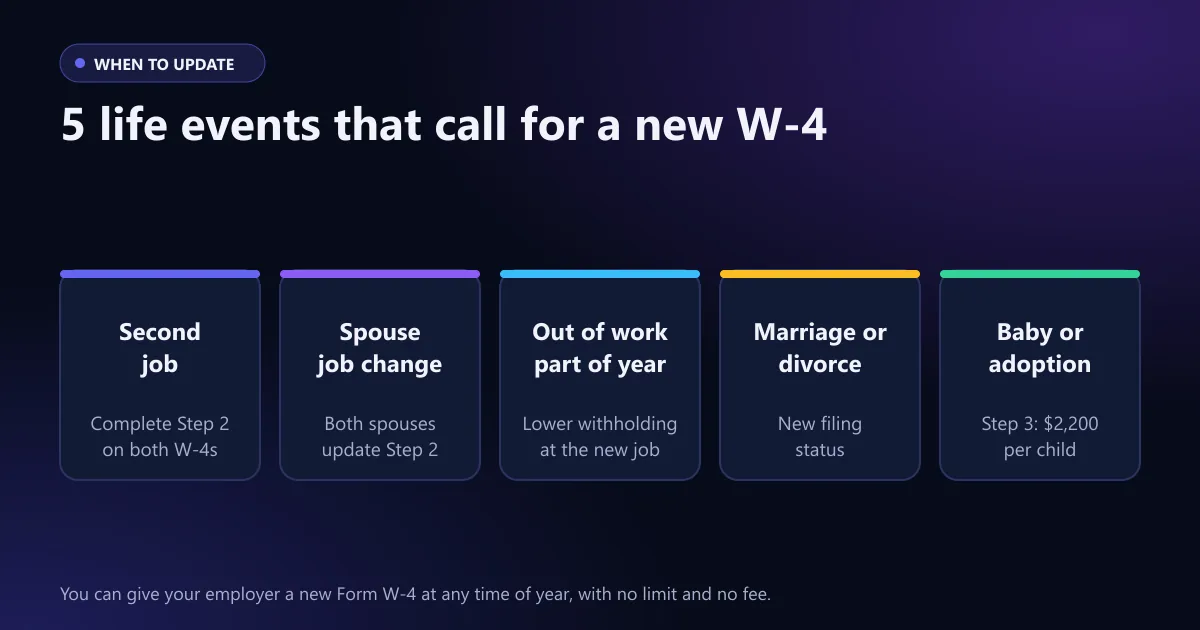
- A new W-4 is worth filing after 5 life events: a second job, a spouse's job change, a period of unemployment, a marriage or divorce, and a birth or adoption.
- You can give your employer a new W-4 at any time of year, and a midyear withholding review takes about 15 minutes with a pay stub and last year's return.
What's a W-4?
A W-4 is the IRS form, titled Employee's Withholding Certificate, that tells your employer how much federal income tax to withhold from each paycheck. You fill out a W-4 form when you start a job, and the employer keeps using that form until you hand in a new one.
The 2026 Form W-4 has 5 steps:
- Step 1 collects your name, address, Social Security number, and filing status.
- Step 2 covers multiple jobs and a working spouse.
- Step 3 claims dependents and other credits, including the Child Tax Credit.
- Step 4 records other income, deductions, and extra withholding per pay period.
- Step 5 holds your signature and the date.
Only Step 1 and Step 5 are required. Steps 2 through 4 are optional, and those 3 steps are where paycheck withholding precision comes from. Your employer never sends the W-4 to the IRS, and the employer's payroll system applies the IRS withholding tables to the entries on the form. Our guide to FIT tax on a paycheck shows that calculation step by step.
What Happens if Too Much or Not Enough Money Is Withheld From Your Paychecks?
Too much withholding produces a tax refund and smaller paychecks, and not enough withholding produces a tax bill and, in many cases, an underpayment penalty.
| Result | Withholding too much | Withholding too little |
|---|---|---|
| Paycheck during the year | Lower take-home pay | Higher take-home pay |
| Outcome at tax filing | Overwithholding refund, paid with no interest | Tax bill for the full shortfall |
| Extra cost | Lost use of the money for up to 16 months | Underwithholding penalty plus interest on underpayment |
| Fix | Lower withholding on a new W-4 | Raise withholding in Step 4(c) or make estimated tax payments |
The underpayment penalty works as interest on the amount you underpaid, for the time it stayed unpaid. The IRS sets the rate each quarter at the federal short-term rate plus 3 percentage points, and the rate ran between 6% and 7% during 2026.
You avoid underpayment penalties under any of 3 withholding safe harbor tests:
- Owe less than $1,000 after subtracting withholding and credits.
- Pay at least 90% of the current year's tax through withholding and estimated tax payments.
- Pay at least 100% of the prior year's tax, or 110% with a prior-year adjusted gross income (AGI) above $150,000.
A safe harbor removes the penalty and leaves the remaining balance due. The IRS treats withholding as paid evenly across the year, so extra withholding in November or December closes a withholding gap that a late estimated tax payment does not.
Why Should I Pay Attention to My W-4?
Pay attention to your W-4 for one reason: the form is the only control you have over federal income tax withholding, and an outdated form produces the wrong amount on every single paycheck. An employee paid biweekly repeats a W-4 error 26 times a year.
A W-4 goes out of date in 4 common ways, including a change in income, a change in filing status, a change in dependents, and a change in tax law. Payroll software does not know about your spouse's salary, your side income, or your new child unless the W-4 says so.
The target taught by Dave Ramsey's Ramsey Solutions, and by most tax planning advice, is a refund or balance due close to $0. A result near $0 means every paycheck carried the correct tax withholding amount, with no loan to the government and no April surprise.
New Tax Law Changes
The new tax law changes come from the OBBBA, signed in July 2025, and the 2026 Form W-4 is the first withholding form built around that law. The IRS released the 2026 form in December 2025 with 2 structural updates: a new "Exempt from withholding" checkbox and a Deductions Worksheet expanded to a full page.
The Deductions Worksheet for Step 4(b) now carries 4 new deductions, which apply to tax years 2025 through 2028:
| New deduction | Maximum amount |
|---|---|
| Qualified tips | $25,000 |
| Qualified overtime compensation | $12,500, or $25,000 for married filing jointly |
| Qualified passenger vehicle loan interest | $10,000 |
| Senior deduction, age 65 or older | $6,000 per person |
The law raised the Child Tax Credit to $2,200 per qualifying child and raised the state and local tax (SALT) deduction cap, and both changes flow into Step 3 and Step 4(b).
These changes do not reach your paycheck automatically. Your employer keeps using the W-4 on file, so a tipped worker, an employee with regular overtime, a new-car buyer, or a worker aged 65 or older stays overwithheld until a 2026 Form W-4 is submitted. Tips and overtime pay remain subject to Social Security withholding and Medicare withholding, and the new deductions lower federal income tax only.
5 Reasons to Adjust Your W-4 Withholding
There are 5 reasons to adjust your W-4 withholding: a second job, a spouse's new job or job change, unemployment for part of the year, a marriage or divorce, and a new baby or adoption. Each life event changes your tax liability, your tax bracket, or your credits, and each one calls for a life event withholding update.
1. You Get a Second Job
Adjust your W-4, when you get a second job, by completing Step 2 on the forms for both jobs. Each employer withholds as if that job were your only income, so each payroll system applies the full standard deduction and the lowest tax brackets to its own wages. The combined income lands in a higher marginal tax rate than either employer assumes, and the result is withholding too little.
Step 2 offers 3 fixes: the IRS Tax Withholding Estimator, the Multiple Jobs Worksheet, and the Step 2(c) checkbox for 2 jobs with similar pay. The same gap applies to freelance, rideshare, and delivery income. Withholding for gig workers does not exist on a Form 1099, so a side income withholding strategy uses Step 4(a) for the other income, Step 4(c) for extra withholding, or quarterly estimated tax payments.
2. Your Spouse Gets a Job or Changes Jobs
Update both spouses' W-4 forms, when your spouse gets a job or changes jobs, since a joint return combines both incomes into one tax bracket calculation. A spouse who moves from $0 to $60,000 in wages pushes part of the household income into a higher bracket, and neither employer sees the other paycheck.
Dual income withholding coordination follows 2 rules. Both spouses complete Step 2, and only the spouse with the higher-paying job completes Step 3 and Step 4(b). Claiming the same child credit or the same deductions on both forms cuts withholding twice and creates a tax bill.
3. You're Unemployed Part of the Year
Lower your withholding, if you're unemployed part of the year, since the withholding tables assume you earn the same paycheck for all 12 months. A worker who earns $5,000 per month for 7 months is taxed on $35,000, and payroll withheld at the rate for a $60,000 salary. The difference comes back as an overwithholding refund unless you adjust the W-4 at the new job.
Unemployment benefits are taxable income on the federal return. Form W-4V, a voluntary withholding request, takes a flat 10% for federal income tax out of each unemployment payment, and skipping that form is one of the most common tax withholding mistakes among people between jobs.
4. You Get Married or Divorced
File a new W-4, when you get married or divorced, since your filing status on December 31 applies to the entire tax year. Marital status withholding impact runs in both directions. Married filing jointly brings a larger standard deduction and wider tax brackets, which lowers withholding for a couple with one income. Two spouses with similar high incomes often owe more together than their two single-status W-4 forms withheld.
Divorce moves you back to single or head of household status, with a smaller standard deduction and narrower brackets. IRS rules call for a new W-4 within 10 days of a divorce, if the change in status reduces the withholding relief you claimed.
5. You Have a Baby or Adopt One
Reduce your withholding in Step 3, when you have a baby or adopt one, since each qualifying child under age 17 brings a Child Tax Credit of $2,200. A credit cuts your tax dollar for dollar, so a dependents withholding adjustment for one child adds about $183 per month to take-home pay instead of to next year's refund.
Step 3 covers 2 dependent amounts: $2,200 for each qualifying child and $500 for each other dependent, for households with income up to $200,000, or $400,000 for married filing jointly. Adoption brings a separate federal adoption credit worth more than $17,000 per child for qualified expenses, which you account for with the IRS Tax Withholding Estimator or a tax withholding calculator.
How Do You Adjust Your W-4 Withholding?
To adjust your W-4 withholding, fill out a new Form W-4 and give the form to your employer's payroll or human resources department. There is no limit on how often you file a new W-4 and no fee.
Adjust tax withholding in 6 steps:
- Gather your most recent pay stub for every job and last year's Form 1040.
- Estimate your full-year tax liability with a tax withholding calculator.
- Compare the estimate with the federal income tax withheld so far plus the amount due on the remaining paychecks.
- Complete a new 2026 Form W-4 with the calculator's results in Steps 2, 3, and 4.
- Submit the form through your employer's payroll portal or on paper.
- Check the next 2 pay stubs to confirm the new withholding from paycheck amounts.
Employers put a new W-4 into effect no later than the first payroll period ending on or after the 30th day after receiving the form, and most payroll systems apply the change within 1 or 2 pay cycles.
Three entries do most of the work. Step 4(c) adds a flat dollar amount of extra withholding per paycheck, which fixes withholding too little. Step 4(b) lowers withholding for deductions above the standard deduction, which fixes withholding too much. Step 3 lowers withholding for credits.
Four situations need attention beyond the standard form:
- Bonuses carry a flat 22% federal supplemental rate, so bonus withholding optimization means checking that 22% against your actual marginal tax rate and correcting the difference in Step 4(c).
- State tax withholding uses a separate state form in most states with an income tax, so a federal W-4 update does not change state withholding.
- Remote work across state lines creates multi-state withholding compliance questions, and withholding for remote work follows the state where you perform the work in most cases.
- Side income without withholding calls for estimated tax alignment, which means either extra W-4 withholding or 4 quarterly estimated tax payments on Form 1040-ES.
Which Tools Help You Figure Out What to Put on Your W-4?
The most direct tool is the free IRS Tax Withholding Estimator, which turns your pay, filing status, dependents, and other income into the entries for each step of the form. Tax software companies, including TurboTax and H&R Block, offer free W-4 calculators that do the same tax liability calibration.
A W-4 calculator asks for 5 inputs: filing status, income from each job, pay frequency, federal tax withheld so far, and dependents. It shows your projected refund or balance due and lets you choose the outcome you want, such as a larger paycheck or a refund near $0. The IRS estimator's output is a completed Form W-4 to download and hand to your employer.
To see how a W-4 change affects each paycheck, enter the same Step 2, 3, and 4 values in the Advanced section of our paycheck calculator and compare take-home pay before and after.
How Does Your Tax Return Show Whether Your Withholding Was Right?
Your tax return compares the federal income tax withheld in Box 2 of each W-2 against your total tax and reports the refund or the balance due. Tax software and paid preparers import your Form W-2 and run that comparison for you.
A refund above $1,000 or a balance due above $1,000 is the signal to file a new W-4 for the current year. Form 2210 calculates the underpayment penalty where one applies, and the safe harbor tests decide whether you owe it.
Free filing is available to many W-2 employees through IRS Free File and IRS-certified volunteer programs. A first year with self-employed income, a multi-state move, a marriage or divorce during the year, or an underpayment penalty notice are the situations where paid expert help is most often worth it.
The Bottom Line
Having the proper amount of taxes withheld from your paycheck comes down to one habit: checking your W-4 after every change in income, filing status, dependents, or tax law. Correct tax withholding keeps you clear of an underpayment penalty, prevents a large tax bill, and keeps your money in your take-home pay.
Start with the IRS Tax Withholding Estimator for the W-4 entries, then use our free paycheck calculator to see what each paycheck will look like. For a line-by-line look at the federal withholding on your stub, read What Is FIT Tax on a Paycheck?.
Articles are general information for US employees and are not tax, legal or financial advice. Tax rules change; check the official IRS or state sources linked on our homepage.