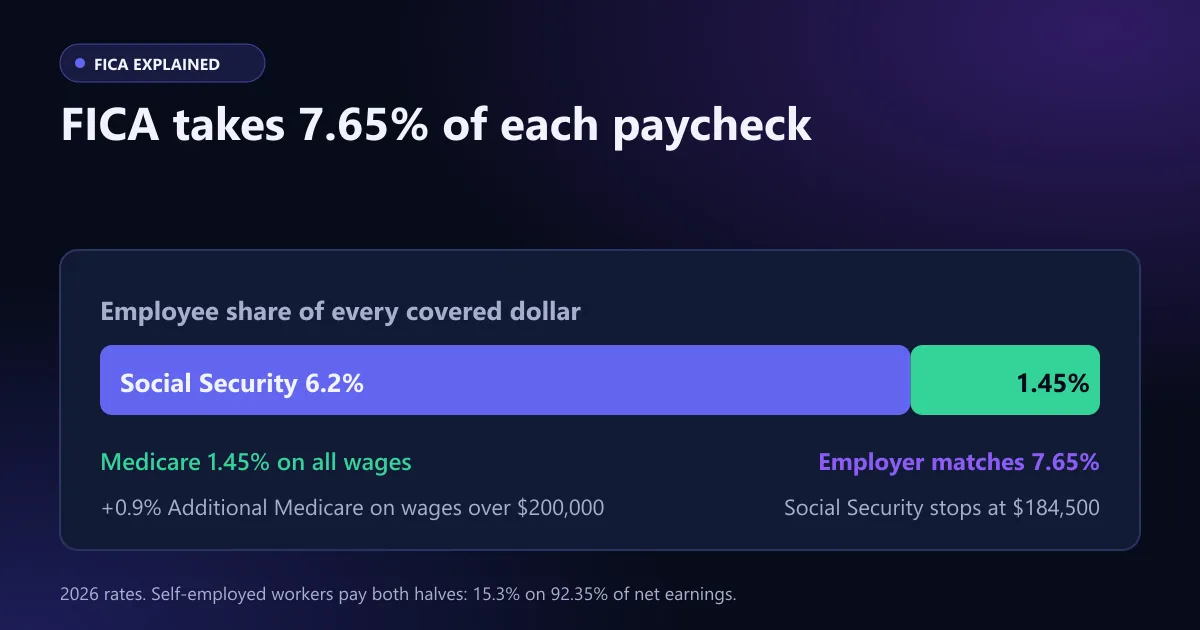
FICA on your paycheck is the federal payroll tax that pays for Social Security and Medicare. Your employer withholds 7.65% of your taxable wages: 6.2% for Social Security and 1.45% for Medicare. It then adds a matching 7.65% of its own and sends both halves to the IRS.
That money buys coverage. Each year of FICA-taxed work earns credits toward retirement, disability and survivor benefits, plus premium-free Medicare Part A at 65. Your FICA tax contributions affect the size of those benefits, since Social Security pays out based on the wages you paid tax on.
This guide breaks the FICA deduction into its parts: Social Security and Medicare taxes, the tax rate, the wage cap and the Additional Medicare Tax. You'll get the 2024 to 2027 rates and limits and a paycheck example that shows how FICA affects you. After that, it covers how FICA and other tax withholding differ and how the self-employed pay. It ends with who is exempt, how FICA shapes your retirement benefits and the new tax law changes on your W-2.
Key Takeaways
- FICA is two taxes on one line: 6.2% for Social Security and 1.45% for Medicare, 7.65% in all. Your employer pays a matching 7.65%.
- Social Security tax stops once your wages for the year pass the wage base: $184,500 in 2026 and $192,300 in 2027. Medicare tax has no cap.
- Wages above $200,000 trigger a 0.9% Additional Medicare Tax. Employers don't match it.
- Your W-4 and tax bracket change your income tax withholding, not FICA. FICA is a flat rate.
- Self-employed people pay both halves, 15.3%, as self-employment tax and deduct half of it.
- Some workers skip FICA, including students working for their own school, many F-1 and J-1 visa holders and some government employees.
- The "no tax on tips" and "no tax on overtime" deductions cut income tax only. FICA still applies to every dollar of tips and overtime.
What Is FICA?
FICA stands for the Federal Insurance Contributions Act. It's the federal law that makes workers and employers fund Social Security and Medicare through payroll tax. The word "insurance" is the point: you pay in while you work, and the programs pay out when you retire, become disabled or die and leave family behind.
The Social Security part is officially OASDI, short for Old-Age, Survivors, and Disability Insurance. The Medicare part is HI, or Hospital Insurance, which funds Medicare Part A. Both come out of the same paycheck, so payroll systems often group them under one FICA label.
Some people call it a FICA fee. It isn't a fee or a voluntary contribution. It's a tax set by Congress, and in a covered job you can't opt out.
Pay stubs don't use one standard label. Here's what the common FICA abbreviations mean.
| Label on your pay stub | What it means |
|---|---|
| FICA | Both taxes combined, or only Social Security when Medicare has its own line |
| SS, OASDI, SOC SEC | Social Security tax, 6.2% |
| MED, MEDI, MEDICARE, FICA MED | Medicare tax, 1.45% |
| FICA HI | Medicare tax; HI stands for Hospital Insurance |
| FED FICA, FED OASDI/EE, FED MED/EE | The same taxes; FED marks them as federal |
| FICA EE | Your share, taken out of your pay |
| FICA ER | Your employer's matching share, shown for your records and not taken out of your pay |
| FICA ALT | A FICA Alternative plan deposit, usually 7.5%, that replaces Social Security tax for some part-time, seasonal and temporary government workers |
| FICA COM | No standard meaning; if the amount is about 7.65% of your taxable pay, it's a combined Social Security and Medicare line |
| ADDL MED or similar | Additional Medicare Tax of 0.9% on wages over $200,000 |
A FICA ALT deposit isn't lost to taxes. It goes into a retirement account in your name, and Medicare tax still comes out as usual.
History of FICA Taxes
Payroll tax for Social Security started in 1937 at 1% of the first $3,000 of wages. Rates and the wage cap have climbed in steps since then.
| Year | What changed |
|---|---|
| 1935 | President Franklin Roosevelt signs the Social Security Act |
| 1937 | Collection starts: 1% from workers and 1% from employers on the first $3,000 of wages |
| 1939 | The tax rules move into the tax code under the name Federal Insurance Contributions Act |
| 1951 | Self-employed workers start paying Social Security tax |
| 1956 | Disability insurance joins the program |
| 1966 | Medicare's hospital insurance tax starts at 0.35% each for workers and employers |
| 1975 | The wage base starts rising automatically with average wages |
| 1990 | Rates reach today's levels: 6.2% for Social Security and 1.45% for Medicare |
| 1994 | The Medicare wage cap ends; every dollar of wages owes Medicare tax |
| 2011–2012 | A payroll tax holiday cuts the employee Social Security rate to 4.2% |
| 2013 | The 0.9% Additional Medicare Tax begins for high earners |
| 2020 | Employers can defer some employee Social Security tax for late 2020; workers repay it in 2021 |
The name stuck. That's why your stub says FICA instead of "Social Security and Medicare tax."
Social Security and Medicare Taxes
FICA pays for two programs. Social Security sends monthly checks to retirees, disabled workers, and the spouses and children of workers who die. Medicare Part A covers hospital stays, skilled nursing care after a hospital stay, hospice and some home health care.
Your taxes don't sit in a personal account. They go into trust funds that pay today's beneficiaries, and any surplus is held in special Treasury bonds. Your work record, not an account balance, decides what you get later.
FICA Tax Rate
The FICA tax rate is 7.65% for you and 7.65% for your employer, 15.3% in total. Congress sets these rates, and they've stayed the same since 1990 apart from the 2011–2012 tax holiday.
| Tax | You pay | Your employer pays | Total |
|---|---|---|---|
| Social Security (OASDI) | 6.2% | 6.2% | 12.4% |
| Medicare (HI) | 1.45% | 1.45% | 2.9% |
| FICA total | 7.65% | 7.65% | 15.3% |
| Additional Medicare Tax (wages over $200,000) | 0.9% | 0% | 0.9% |
On a $1,000 paycheck, that's $62.00 for Social Security and $14.50 for Medicare, or $76.50. Your employer pays another $76.50 that never shows as a deduction.
The same rates apply to bonuses, commissions, overtime, reported tips and most taxable fringe benefits. Federal income tax on a bonus can use a flat 22% rate, but FICA on that bonus is still 7.65%.
FICA Tax Limit for Social Security
Social Security tax only applies up to a yearly cap called the wage base, or taxable maximum. The cap is $184,500 for 2026 and $192,300 for 2027. Once your year-to-date wages pass it, Social Security withholding stops until January 1. Medicare tax keeps going on every dollar.
That's why some high earners see bigger checks late in the year. Say you earn $300,000 in 2026, paid every two weeks. Each check is $11,538.46, and you hit the cap during your 16th paycheck, around August. From the 17th check on, your net pay rises by about $715.
Two jobs can trip you up. Each employer withholds Social Security tax up to the cap on its own, so your combined withholding can top the yearly maximum of $11,439 for 2026. You get the extra back as a credit on Schedule 3 of Form 1040. With $120,000 from one job and $100,000 from another in 2026, $13,640 is withheld and $2,201 comes back at tax time.
If a single employer withholds too much, ask it to fix the error and refund you. If it won't, file Form 843 with the IRS. Your employers don't get their extra matching tax back.
Additional Medicare Tax Rules
The Additional Medicare Tax adds 0.9% on wages and self-employment income above a threshold set by your filing status.
| Filing status | Threshold |
|---|---|
| Single, head of household, qualifying surviving spouse | $200,000 |
| Married filing jointly | $250,000 |
| Married filing separately | $125,000 |
Your employer must start withholding the extra 0.9% in the pay period your wages from that job pass $200,000, whatever your filing status. There's no employer match. The thresholds aren't indexed for inflation, so more workers cross them each year.
Withholding and the tax you owe can differ, so you settle up on Form 8959 with your return:
- Two spouses earning $150,000 each owe 0.9% on $50,000, or $450. Neither employer withheld any of it.
- One spouse earning $210,000 with a non-working partner owes nothing extra. The $90 withheld comes back.
You can't ask your employer to withhold more Additional Medicare Tax. You can raise your federal income tax withholding on Form W-4 or make estimated payments to cover it. The 0.9% doesn't touch investment income; that falls under the separate 3.8% Net Investment Income Tax. See IRS Topic No. 560 for the full rules.
FICA Rates and Limits, 2024–2027
FICA rates haven't changed since 1990, but the Social Security wage base rises almost every year with average wages. Here are the 2024 and 2025 figures, plus 2026 and the 2027 limits the Social Security Administration announced in October 2026.
| Item | 2024 | 2025 | 2026 | 2027 |
|---|---|---|---|---|
| Social Security rate, employee and employer each | 6.2% | 6.2% | 6.2% | 6.2% |
| Medicare rate, employee and employer each | 1.45% | 1.45% | 1.45% | 1.45% |
| Social Security wage base | $168,600 | $176,100 | $184,500 | $192,300 |
| Most Social Security tax one employee can owe | $10,453.20 | $10,918.20 | $11,439.00 | $11,922.60 |
| Most Social Security tax a self-employed person can owe (12.4%) | $20,906.40 | $21,836.40 | $22,878.00 | $23,845.20 |
| Medicare wage cap | None | None | None | None |
| Additional Medicare Tax threshold (single / joint) | $200,000 / $250,000 | $200,000 / $250,000 | $200,000 / $250,000 | $200,000 / $250,000 |
| Earnings for one Social Security credit | $1,730 | $1,810 | $1,890 | $1,970 |
| Household employee FICA threshold | $2,700 | $2,800 | $3,000 | $3,100 |
| Election worker FICA threshold | $2,300 | $2,400 | $2,500 | $2,700 |
Figures come from the Social Security Administration's contribution and benefit base, credit and coverage threshold tables. Self-employed people pay 15.3% (12.4% for Social Security plus 2.9% for Medicare) on 92.35% of net earnings, under the same wage base.
How FICA Impacts You
So how does FICA affect you? It takes a fixed 7.65% out of each check, and it builds the work record your future benefits come from.
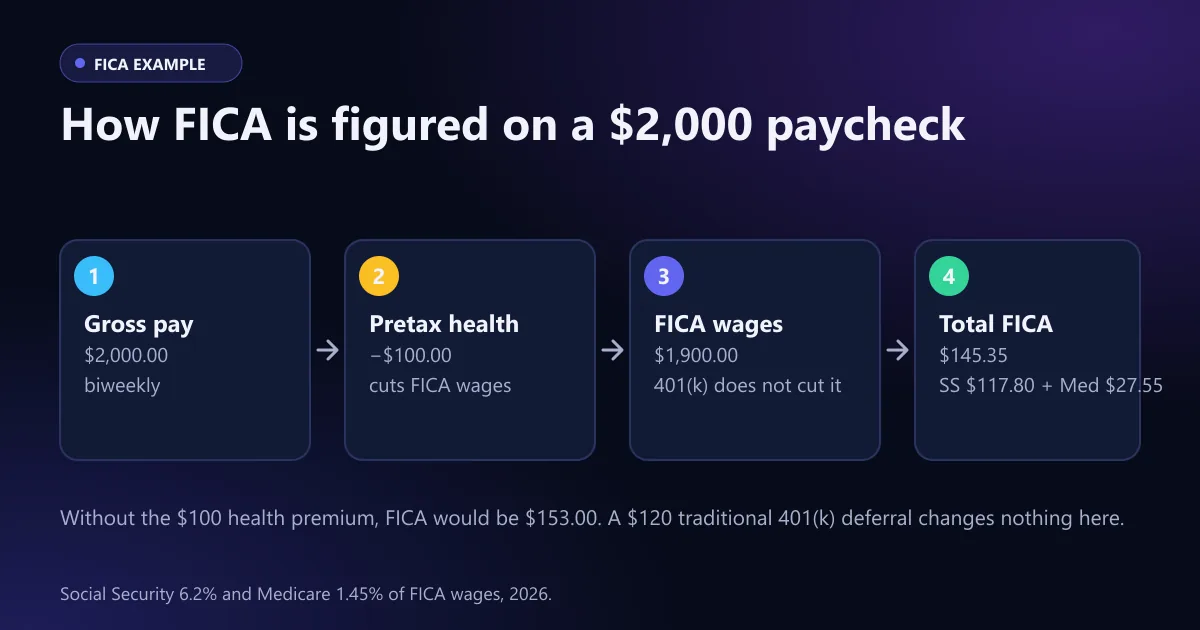
Take a $2,000 biweekly paycheck with a $100 pretax health premium and a $120 traditional 401(k) deferral.
| Line | Amount | How it's figured |
|---|---|---|
| Gross pay | $2,000.00 | Before any deductions |
| Pretax health premium | −$100.00 | Lowers both FICA wages and income tax wages |
| Traditional 401(k) deferral | −$120.00 | Lowers income tax wages only |
| FICA wages | $1,900.00 | $2,000 minus $100 |
| Social Security tax | $117.80 | 6.2% of $1,900 |
| Medicare tax | $27.55 | 1.45% of $1,900 |
| Total FICA | $145.35 | 7.65% of $1,900 |
| Federal income tax wages | $1,780.00 | $2,000 minus $100 minus $120 |
Your employer pays its own $145.35 on top. Without the health premium, FICA would be $153.00.
That's the pretax benefit rule most people miss. Health, dental, vision, FSA and HSA payroll deductions run through a cafeteria plan cut your FICA. Traditional 401(k) and 403(b) deferrals don't. You can test both kinds of deduction in the Advanced section of our paycheck calculator.
At year-end, your W-2 shows the FICA side in its own boxes:
- Box 3: Social Security wages, capped at the wage base
- Box 4: Social Security tax withheld
- Box 5: Medicare wages, with no cap
- Box 6: Medicare tax withheld, including any Additional Medicare Tax
- Box 7: Social Security tips
Box 1 is often lower than Boxes 3 and 5. The gap is usually your 401(k) deferrals, which skip income tax but not FICA.
If you earn tips, report them to your employer for any month you get $20 or more. Your employer withholds FICA on them from your regular pay. When your pay is too small to cover it, the unpaid tax shows in Box 12 under codes A and B, and you pay it with your return. Tips you never reported go on Form 4137.
When an employer pays your share of FICA for you, say on a grossed-up bonus, the amount it covers counts as more wages. FICA applies to that amount too.
Working in two states changes your state income tax, not FICA. FICA is federal, so the rate and wage base are the same in every state.
What Is Withholding?
Withholding is money your employer holds back from each paycheck and sends to the government for you. It keeps you paying tax as you earn, instead of in one lump sum in April. Your employer reports what it withheld every quarter on Form 941 and to you on your W-2 each January.
A typical paycheck has several kinds of tax withholding: federal income tax, FICA, state and local income tax, and in some states disability or paid leave insurance.
What Determines How Much My Employer Sets Aside for FICA and Other Tax Withholding?
For FICA, your employer sets aside a fixed share of your FICA wages. Only a few things move that number: your pay, pretax cafeteria plan deductions, reported tips, your year-to-date total against the wage base and whether you've passed $200,000.
Federal income tax withholding works differently. It depends on your Form W-4 answers, how often you're paid and the IRS withholding tables. Bonuses and commissions can be withheld at a flat 22%, or 37% on supplemental pay over $1 million in a year. Our guide to FIT tax on a paycheck walks through that calculation.
| Factor | Changes FICA withholding? | Changes federal income tax withholding? |
|---|---|---|
| Gross pay | Yes | Yes |
| Form W-4 answers, including filing status and dependents | No | Yes |
| Traditional 401(k) deferrals | No | Yes, lowers it |
| Pretax health, dental, vision, FSA or HSA deductions | Yes, lowers it | Yes, lowers it |
| Bonus or commission | Yes, same 7.65% | Yes, often a flat 22% |
| Year-to-date wages | Yes, Social Security stops at the wage base | No |
| Wages over $200,000 from one employer | Yes, adds 0.9% | No |
How Does Your Tax Bracket Impact How Much FICA Is Withheld?
It doesn't. Tax brackets, from 10% to 37%, apply only to federal income tax. FICA is a flat 7.65% on every covered dollar, whether you earn $30,000 or $150,000.
Income level matters in two places. Social Security tax stops at the wage base, and the 0.9% Additional Medicare Tax starts above $200,000. The share of pay FICA takes falls once you pass the cap.
| 2026 salary (single filer, one job) | Total employee FICA | Share of salary |
|---|---|---|
| $50,000 | $3,825 | 7.65% |
| $150,000 | $11,475 | 7.65% |
| $250,000 | $15,514 | 6.21% |
| $500,000 | $21,389 | 4.28% |
A raise that moves you into a higher tax bracket raises your income tax, not your FICA rate. Each new dollar still owes the same 7.65% until you reach the wage base. In the 22% bracket, your combined federal rate on a raise is 29.65% (22% plus 7.65%) before state tax.
Differences Between FICA and Other Tax Withholdings
FICA and federal income tax both show up as deductions, but they work in opposite ways. FICA is a flat tax for two programs. Income tax is a graduated tax for the whole federal budget, and you square it up on your return each spring.
| Withholding | What it pays for | Rate | Set by your W-4? | Settled at tax time? |
|---|---|---|---|---|
| FICA | Social Security and Medicare | 7.65% flat, plus 0.9% over $200,000 | No | Only in special cases, such as two jobs or the 0.9% tax |
| Federal income tax | General federal spending | 10% to 37% brackets | Yes | Yes, on Form 1040, as a refund or balance due |
| State and local income tax | State and city budgets | Varies; nine states don't tax wages | Often a state form | Yes, on your state return |
| State disability or paid leave | Short-term disability and family leave | Set by your state | No | No |
FUTA, the federal unemployment tax, is paid by employers only, so it never appears as a deduction on your stub. A few states take a small employee share for unemployment insurance. See how each state handles wages in our state-by-state guide.
How FICA Works for the Self-Employed
When you work for yourself, no employer splits the bill. You pay both halves as self-employment tax: 15.3%, made up of 12.4% for Social Security and 2.9% for Medicare. It's the same system under a sister law, the Self-Employment Contributions Act.
You owe it once your net earnings from self-employment reach $400 for the year. You figure it on Schedule SE and pay it with your Form 1040.
Three rules shape the math:
- You pay on 92.35% of your net profit, not 100%. The 7.65% cut mirrors the employer share that a W-2 worker never sees.
- The Social Security part stops at the wage base, and your W-2 wages count toward that cap first.
- You deduct half of your self-employment tax as an adjustment to income. That lowers income tax, not the self-employment tax itself.
Here's 2026 self-employment tax on $60,000 of net profit.
| Step | Amount |
|---|---|
| Net profit from Schedule C | $60,000.00 |
| Times 92.35% | $55,410.00 |
| Social Security at 12.4% | $6,870.84 |
| Medicare at 2.9% | $1,606.89 |
| Self-employment tax | $8,477.73 |
| Half you deduct on Schedule 1 | $4,238.87 |
No one withholds it for you. Pay it through quarterly estimated taxes on Form 1040-ES, due in mid-April, mid-June, mid-September and mid-January. If you hold a W-2 job too, you can raise withholding there on Form W-4 to cover it.
Business expenses cut net profit, so they cut both self-employment tax and income tax. $10,000 of expenses saves about $1,413 in self-employment tax alone. The self-employed health insurance deduction and SEP or solo 401(k) contributions work differently: they lower income tax only.
A few special cases:
- S corporation owners pay FICA on a reasonable salary through payroll. Profits paid out as distributions skip FICA, which is why the IRS watches for salaries set too low.
- Statutory employees, such as some commission delivery drivers, full-time life insurance agents and traveling salespeople, get a W-2 with Box 13 checked. Their employer withholds FICA, and they report the income on Schedule C without owing self-employment tax on it.
- Ministers pay self-employment tax on ministry earnings, even when a church issues a W-2. A clergy housing allowance is free of income tax but still counts for self-employment tax.
Who Doesn't Have to Pay FICA Taxes?
Most workers in the U.S. pay FICA from their first paycheck. The FICA tax exemptions are narrow, and each one comes with conditions.
| Worker | What they skip | Condition |
|---|---|---|
| Students working for their own school | Social Security and Medicare | Enrolled at least half-time and employed by that same school, college or university |
| Foreign students and scholars on F-1, J-1, M-1 or Q visas | Social Security and Medicare | Still a nonresident alien for tax purposes, usually the first 5 calendar years for students and 2 for J-1 scholars |
| Some state and local government workers | Social Security; most still pay Medicare | Covered by a public retirement plan that replaces Social Security |
| Part-time, seasonal and temporary government workers | Social Security | Enrolled in a FICA Alternative plan instead (FICA ALT on the stub) |
| Children working for a parent | Social Security and Medicare | Under 18 in a parent's sole proprietorship or a partnership of both parents |
| Household workers | Social Security and Medicare | Paid less than $3,000 by one household in 2026 ($3,100 in 2027), or under 18 when household work isn't their main job |
| Election workers | Social Security and Medicare | Paid less than $2,500 in 2026 ($2,700 in 2027) |
| Members of some religious groups, and ministers | Social Security and Medicare | IRS approval on Form 4029 (religious groups) or Form 4361 (ministers, for ministry earnings only) |
| Railroad workers | FICA | They pay Railroad Retirement taxes instead |
The student exception doesn't cover full-time career staff who happen to take classes. Spouses and dependents on F-2, J-2 or M-2 visas aren't exempt, and H-1B workers pay FICA like anyone else.
If FICA came out of your pay by mistake, say as an F-1 student, ask your employer for a refund first. If it won't, file Form 843 with Form 8316 to claim it from the IRS.
Workers sent here briefly by an employer from a country with a U.S. Social Security agreement may keep paying into their home system instead.
Skipping FICA has a cost. Those years earn no Social Security credits, which can leave you with a smaller benefit or none at all.
How FICA Impacts Your Social Security and Medicare Benefits in Retirement
Your FICA tax contributions affect three things: whether you qualify, how big your check is and whether Medicare Part A is free. Every dollar of wages taxed for Social Security, up to the wage base, goes on your earnings record.
Credits. You earn one Social Security credit for each $1,890 of covered earnings in 2026 ($1,970 in 2027), up to four a year. You need 40 credits, about 10 years of work, to qualify for retirement benefits.
Benefit size. Social Security indexes your past earnings for wage growth, then averages your highest 35 years. Years with no earnings count as zeros. Pay above the wage base never counts, so the cap limits both the tax and the benefit.
Claiming age. Full retirement age is 67 for anyone born in 1960 or later. You can claim at 62 for a permanently smaller check, or wait until 70 for a bigger one.
Medicare. With 40 credits, you get Medicare Part A at 65 without a monthly premium. With 30 to 39 credits, you pay a reduced Part A premium; with fewer, you pay the full premium. Part B and Part D carry their own premiums, which FICA doesn't cover.
Your record. Check your earnings history every year in your my Social Security account, and compare it with Box 3 of your W-2s. Fix mistakes early, while your old pay stubs and W-2s are easy to find.
The trust funds. The 2026 Social Security Trustees Report projects that the retirement trust fund runs dry in late 2032. After that, incoming payroll taxes would cover about 78% of scheduled retirement benefits unless Congress acts. The combined Social Security funds last until 2034, and Medicare's hospital insurance fund until 2033. Benefits don't stop at that point; they shrink.
New Tax Law Changes
Several recent changes touch FICA or the forms that report it.
Tips and overtime deductions (2025–2028). The One Big Beautiful Bill Act, signed July 4, 2025, lets eligible workers deduct up to $25,000 of qualified tips. It lets them deduct up to $12,500 of qualified overtime pay ($25,000 on a joint return), meaning the extra half in time-and-a-half. Both deductions shrink once modified AGI passes $150,000 ($300,000 joint). They cut federal income tax only. Social Security and Medicare taxes still apply to every dollar of tips and overtime, so your paycheck looks the same during the year.
Senior deduction. People 65 and older get an extra $6,000 deduction for 2025 through 2028, phasing out above $75,000 of modified AGI ($150,000 joint). It lowers income tax. It doesn't change FICA, and it doesn't end tax on Social Security benefits.
New W-2 codes. Starting with 2026 W-2s, which employers must hand out by February 1, 2027, Box 12 adds code TP for tips, TT for qualified overtime and TA for employer deposits to a Trump account. Box 14b shows your tipped occupation code, and Box 7 still shows Social Security tips. 2025 W-2s don't have these codes, so check your final 2025 pay stub or a separate statement from your employer.
Employer tip credit. The FICA tip credit lets employers claim a credit for their share of FICA on certain tips. It now covers beauty businesses such as barbershops, hair and nail salons and spas, on top of restaurants and bars.
Social Security Fairness Act. Signed January 5, 2025, it repealed the Windfall Elimination Provision and the Government Pension Offset. People with pensions from jobs that didn't pay into Social Security, often teachers, police officers and firefighters, no longer see their Social Security cut for that pension. The change applies to benefits payable after December 2023.
Roth catch-up rule. Since January 1, 2026, workers 50 and older whose prior-year FICA wages from their employer topped $150,000 must make 401(k)-type catch-up contributions as Roth. The number in Box 3 of your W-2 now decides how you can save.
Higher wage base. The Social Security wage base rises to $192,300 in 2027, up from $184,500, so the most an employee can owe in Social Security tax becomes $11,922.60.
Which FICA Items Show Up on Your Tax Return?
For most W-2 workers, FICA is settled before tax season starts. Your employer already withheld it and reported it. But a few FICA items do land on your return:
- Schedule SE for self-employment tax
- Form 8959 for the Additional Medicare Tax
- Schedule 3 for extra Social Security withheld by two or more employers
- Form 4137 for tips you didn't report to your employer
- Schedule H if you pay a nanny or other household worker
- Form 8919 if you were treated as a contractor but should have been an employee
These forms can push you out of the simplest free filing options. IRS Free File and IRS-certified volunteer programs (VITA and TCE) help many filers at no cost. A CPA or enrolled agent makes sense for S corporation salaries, worker classification disputes or several years of FICA errors.
The Bottom Line on FICA
FICA on your paycheck comes down to a few numbers: 6.2% for Social Security up to the wage base, 1.45% for Medicare on every dollar and 0.9% more above $200,000. Those Social Security and Medicare taxes don't change with your W-4 or tax bracket, which is the main difference between FICA and other tax withholding. If you're self-employed, you pay both halves.
Your FICA tax contributions shape the retirement and Medicare benefits you collect later. Check your W-2 boxes and your earnings record each year, and watch for new tax law changes; the wage base moves every January.
Want to see FICA next to every other deduction? Run your numbers in the free paycheck calculator, or read our guides to OASDI tax and FIT withholding.
Articles are general information for US employees and are not tax, legal or financial advice. Tax rules change; check the official IRS or state sources linked on our homepage.