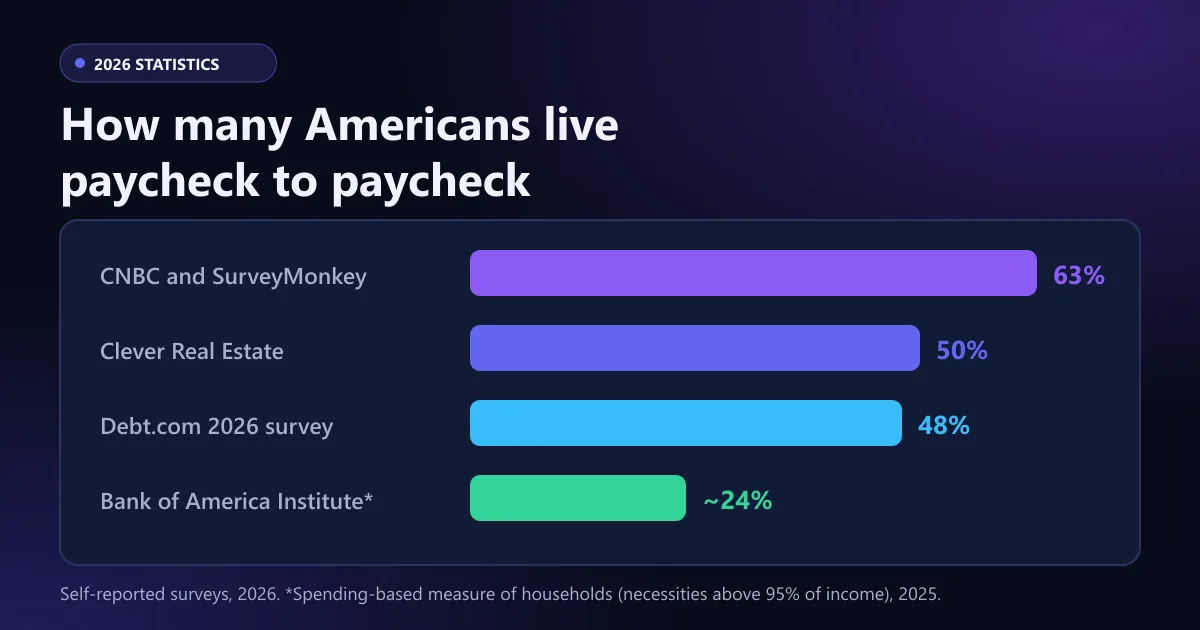
Living paycheck to paycheck means a household spends all or nearly all of each paycheck on expenses before the next paycheck arrives, with little or no money left to save. Between 48% and 63% of Americans describe their finances this way in 2026 surveys. The condition has 5 parts: income, expenses, bills, debt, and savings. Economists and lenders use the term to measure financial fragility, and households use it to judge how exposed a budget is to one unexpected expense.
This article defines paycheck to paycheck, shows who lives this way, follows the trend from the pandemic to 2026, lists the warning signs, and gives 8 steps to stop living paycheck to paycheck. Breaking the paycheck-to-paycheck cycle brings 3 main benefits: an emergency fund that absorbs surprise bills, less high-interest debt, and lower financial stress.
What Is Paycheck to Paycheck?
Paycheck to paycheck is a financial condition in which income covers current expenses and leaves little or nothing to save. A household in this condition depends on the next paycheck to pay rent, utilities, groceries, and debt payments, and a missed or reduced paycheck means a missed bill.
The paycheck to paycheck meaning changes with the source. There are 2 common definitions:
- Self-reported definition: a person answers yes to a survey question about living paycheck to paycheck. Surveys from Debt.com, CNBC, and Clever Real Estate use this approach.
- Spending-based definition: a household spends a set share of income on necessities. The Bank of America Institute counts a household as paycheck to paycheck when necessity spending, including housing, groceries, gas, utilities, and childcare, exceeds 95% of income.
Does living paycheck to paycheck include savings? Yes, a household with savings lives paycheck to paycheck when monthly income leaves no surplus to add to those savings. A retirement account or a small savings account does not change the monthly cash flow. People call the same condition living hand-to-mouth, living from hand to mouth, or struggling to make ends meet.
Key Takeaways
- Living paycheck to paycheck means spending nearly all income on expenses, with a zero financial buffer for emergencies.
- Surveys in 2026 place the share of Americans living paycheck to paycheck between 48% and 63%, and a stricter spending-based measure places the share near 24% of households.
- High earners live paycheck to paycheck too: about 19% of higher-income households meet the spending-based definition.
- Rising cost of living, wage stagnation, debt payments, and spending habits are the 4 main causes.
- A realistic budget, an emergency fund, and a debt repayment plan are the 3 core tools to break the paycheck-to-paycheck cycle.
Understanding Paycheck to Paycheck
Paycheck to paycheck living comes from an income-to-expense deadlock: expenses rise to match income, and nothing remains at the end of the month. There are 4 main causes:
- Cost of living. Rent, groceries, insurance, and childcare take a larger share of each paycheck as prices rise.
- Wage stagnation. Pay raises that trail inflation shrink the real value of a salary or hourly wage.
- Debt payments. Credit card debt, auto loans, and student loans claim income before a household spends a dollar on current needs.
- Spending habits. Lifestyle spending grows with income and absorbs every raise.
Most people in this position blame prices, not spending habits. In a July 2026 Clever Real Estate survey, 53% of Americans living paycheck to paycheck said inflation made necessities too expensive, and 18% said they overspend on nonessentials. In the same survey, 45% said their household needs an extra $2,000 a month to break the cycle.
Who Lives This Way?
People at every income level live paycheck to paycheck, and the share is highest among lower-income households, renters, and adults in their 20s and 30s.
- Lower-income households: 29% meet the Bank of America Institute spending-based definition, up from 27.1% in 2023.
- Higher-income households: about 19% meet the same definition, and the Bank of America Institute links this group to lifestyle creep. Living paycheck to paycheck on $100k is common in high-cost cities, where housing and childcare consume a six-figure salary.
- Younger adults: 57% of Gen Z and 62% of millennials say they live paycheck to paycheck, compared with 50% of all Americans, per Clever Real Estate. Entry-level pay, student loans, and first-time rent drive the pattern in the 20s, and childcare and housing costs drive the pattern in the 30s.
- Renters: 61% of non-homeowners live paycheck to paycheck, compared with 42% of homeowners.
- Families with kids: childcare, food, and health insurance add fixed bills that a single paycheck often does not cover.
Specific groups face higher risk, including the working poor, minimum wage earners, gig workers, single parents, and college students living on loans. Hourly workers in retail, food service, and warehousing face variable hours that change the size of each paycheck.
The Need for More Than One Job
About 8.7 million Americans, or 5.5% of all employed people, held more than one job in July 2026, according to a Federal Reserve Bank of Richmond brief. The share fell to 4.1% in April 2020, rose every year after, and peaked at 6.0% at the end of 2025.
A second job adds real income. The Richmond Fed estimates annual second-job earnings at $19,867 in 2026 dollars. A second job reduces time for rest, family, and training for better-paid work, so extra hours work best as a short-term step that funds an emergency fund or pays off debt. If you take on a second job, update your W-4 so both jobs withhold enough tax; our guide to why proper withholding matters explains how.
Paycheck to Paycheck and the Pandemic
The pandemic changed paycheck to paycheck living in 2 phases: a short period of relief, then a sharp rise.
Phase 1, 2020 to 2021: relief. The U.S. unemployment rate reached 14.8% in April 2020. Three rounds of stimulus payments ($1,200, $600, and $1,400 per eligible adult), expanded unemployment benefits, and paused federal student loan payments raised household cash. Lockdowns cut spending on travel, dining, and commuting. LendingClub and PYMNTS reported 52% of consumers living paycheck to paycheck in April 2021, a low point for that survey.
Phase 2, 2022 onward: rising costs. Pandemic aid ended, and annual inflation peaked at 9.1% in June 2022. Households spent down pandemic savings to cover rent, food, and gas. The LendingClub and PYMNTS figure climbed to 64% by December 2022, including about 8 million people earning more than $100,000 a year.
Paycheck to Paycheck Trend Persists
Paycheck to paycheck living remains widespread in 2026, with the direction depending on the survey.
- Debt.com: the 2026 Budgeting Survey found 48% of Americans living paycheck to paycheck, down from a record 69% in 2025 and close to the 50% reported in 2022.
- CNBC and SurveyMonkey: a July 2026 survey found 63% living paycheck to paycheck, and 90% of that group had less than $500 left each month after expenses.
- Clever Real Estate: 50% of Americans live paycheck to paycheck, and 74% of that group expect to live the same way a year from now.
- Bank of America Institute: nearly 24% of households met the spending-based definition in 2025, and growth in that share slowed compared with 2024.
Budgeting alone does not end the pattern. Debt.com found 85% of Americans keep a budget, yet nearly half still live paycheck to paycheck.
Signs You Are Living Paycheck to Paycheck
There are 7 common signs of living paycheck to paycheck. Count the signs that match your finances, and treat 3 or more as confirmation.
- Your checking account balance falls near zero before each payday.
- Your savings account holds less than one month of living expenses.
- Your credit card covers groceries, gas, or monthly bills, and the balance carries over.
- Your bills get paid late or in rotation, with one bill skipped each month.
- Your budget has no room for error: a $400 car repair requires borrowing.
- Your pay raises disappear into higher spending within a few months.
- Your thoughts return to money daily, and financial stress affects sleep or mood.
Is living paycheck to paycheck normal? Yes, living paycheck to paycheck is common: about half of Americans report it. Common does not mean safe. A household with no savings has no protection against a job loss, a medical bill, or a reduced paycheck.
How to Stop Living Paycheck to Paycheck
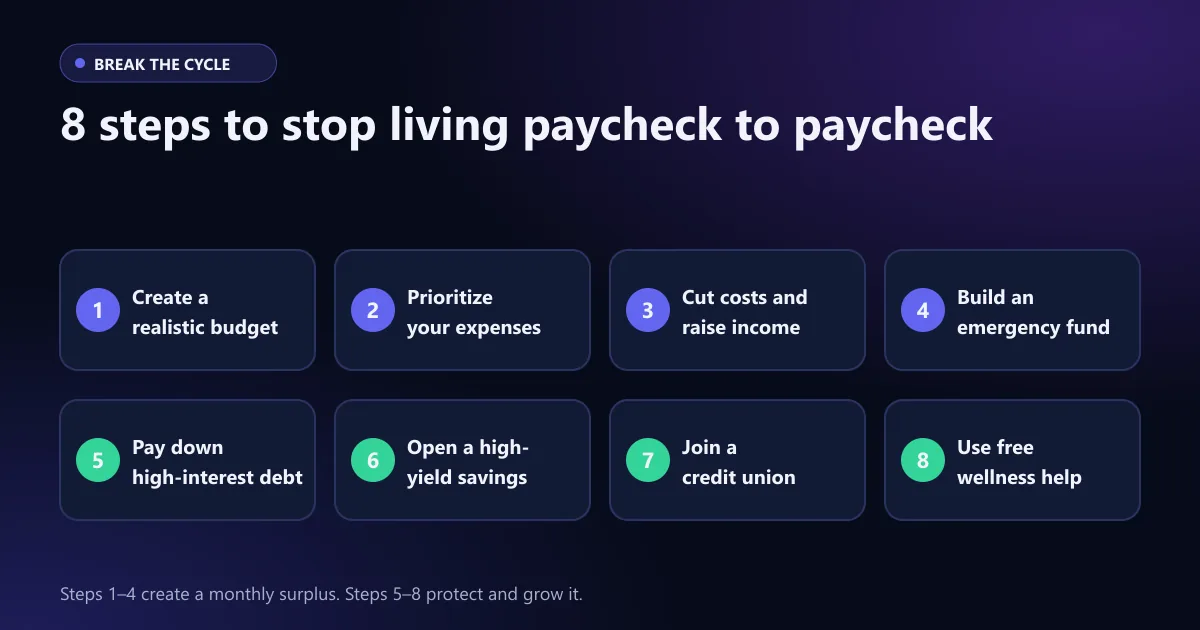
To stop living paycheck to paycheck, follow 8 steps: create a realistic budget, prioritize your expenses, cut expenses and increase income, build an emergency fund, manage and eliminate debt, open a high-yield savings account, join a credit union, and use free financial wellness resources. The first 4 steps create a monthly surplus, and the last 4 steps protect and grow that surplus.
1. Create a Realistic Budget
To create a realistic budget, list your monthly take-home income, list every expense, and assign each dollar a job before the month starts. A realistic budget uses actual spending from the last 3 months, not ideal numbers.
There are 2 proven budgeting methods for a paycheck to paycheck budget:
- 50/30/20 rule: 50% of take-home pay goes to needs, 30% to wants, and 20% to savings and debt repayment. On $4,000 of monthly take-home pay, the split is $2,000, $1,200, and $800. Households with high rent start with a 60/30/10 split and move toward 50/30/20.
- Zero-based budgeting: income minus planned expenses, savings, and debt payments equals zero. Every dollar has an assignment, which stops untracked spending.
Use goal setting as a guide and motivation. Set 1 short-term goal and 1 long-term goal, each with a dollar amount and a date. "Save $1,000 by June 30" works. "Save more money" does not. Goal setting turns a budget from a list of limits into a plan with a finish line, and each completed goal builds the habit for the next one.
Optimize your budgeting strategies. Use these 4 budgeting strategies to make a budget hold:
- Budget by paycheck: assign specific bills to each paycheck, so rent comes from the first paycheck of the month and utilities and insurance come from the second. Our pay frequency guide explains how biweekly and semimonthly schedules differ.
- Split your direct deposit: send a fixed amount of each paycheck to a savings account before the money reaches checking.
- Turn on online banking alerts: set a low-balance alert and a large-purchase alert.
- Move due dates: ask billers to shift due dates to the days after payday.
2. Prioritize Your Expenses
To prioritize your expenses, pay for the 4 basic needs first: housing, utilities, food, and transportation. Minimum debt payments and insurance come next. Wants, including streaming, dining out, and hobbies, come last.
Review your expenses. Download 90 days of bank and credit card statements and sort every transaction into 3 groups: fixed needs, variable needs, and wants. Expense tracking for 90 days captures quarterly bills and irregular purchases that a single month hides. Total each group and compare the totals with your take-home income.
Identify areas to reduce spending. There are 5 areas where most households reduce spending fastest:
- Subscriptions: cancel unused streaming, app, and gym memberships.
- Groceries: plan meals, buy store brands, and shop with a list.
- Dining and delivery: set a fixed weekly amount in cash.
- Insurance: compare auto and renters insurance quotes once a year.
- Phone and internet: switch to a prepaid or lower-tier plan.
3. Cut Expenses and Increase Income
To cut expenses and increase income, work on both sides of the budget in the same month. Cutting has a floor, and income has no ceiling.
Cut the largest bills first. Housing, transportation, and food make up the majority of a typical budget, so a roommate, a cheaper car, or a refinanced auto loan frees more cash than canceling a $10 subscription.
There are 5 ways to increase income:
- Ask for a raise with market pay data for your role.
- Apply for a higher-paying job, which often raises a salary faster than an annual review.
- Work overtime or a part-time second job for a fixed period.
- Sell unused items, including electronics, furniture, and tools.
- Adjust your W-4 withholding, if you receive a large tax refund each year. A $3,000 refund equals $250 of extra take-home pay per month.
4. Build an Emergency Fund
To build an emergency fund, save a starter amount of $500 to $1,000 first, then grow the fund to 3 to 6 months of living expenses. The starter fund stops the most common cause of new debt: a car repair, a medical bill, or a broken appliance charged to a credit card.
Put some cash aside from every paycheck, even a small amount. $25 a week adds up to $1,300 in a year. This is how to save money while living paycheck to paycheck: automate a small transfer on payday, and raise the amount with each raise, tax refund, or paid-off debt. Keep emergency savings in a separate account from checking, so the money stays out of daily spending. Our guide on how much of your paycheck to save covers savings targets in more detail.
5. Manage and Eliminate Debt
To manage and eliminate debt, stop adding new balances, pay the most expensive debt first, and follow a written repayment plan. Living paycheck to paycheck and in debt means spending tomorrow's earnings today: each interest charge reduces the next paycheck before it arrives.
Stop accruing debt. Remove saved credit cards from shopping sites, pay for daily purchases with a debit card or cash, and avoid payday loans and buy-now-pay-later plans. A typical two-week payday loan with a $15 fee per $100 borrowed carries an annual percentage rate (APR) of almost 400%, according to the Consumer Financial Protection Bureau (CFPB).
Pay down high-interest debt first. Pay the minimum on every debt, then send every extra dollar to the debt with the highest interest rate. Credit cards commonly charge 20% APR or more, so each $1,000 of card balance costs about $200 a year in interest. This approach is the debt avalanche method, and it produces the lowest total interest cost. The debt snowball method pays the smallest balance first and suits people who need quick wins to stay on plan.
Consider debt consolidation. Debt consolidation combines several debts into 1 loan with 1 payment and a lower rate. Moving a $6,000 balance from a 24% APR credit card to a 12% APR personal loan cuts the annual interest charge on that balance from about $1,440 to about $720. Consolidation works when the new rate is lower and the paid-off cards stay unused. Check the origination fee and total repayment cost before signing.
Create a debt repayment plan. Build a debt repayment plan in 4 steps:
- List every debt with its balance, interest rate, and minimum payment.
- Rank the debts by interest rate, highest first.
- Set a fixed extra payment amount from your budget.
- Roll each finished payment into the next debt on the list.
6. Open a High-Yield Savings Account
To open a high-yield savings account, compare annual percentage yield (APY), monthly fees, and minimum balance at online banks and credit unions, then apply online with your ID and a funding account. A high-yield savings account pays several times the interest of a standard savings account, and Federal Deposit Insurance Corporation (FDIC) coverage protects deposits up to $250,000 per depositor at each insured bank.
A money market account is a similar option that pays a competitive rate and adds check or debit access. Read the account disclosures for rate tiers, fees, and withdrawal limits before opening either account. Then set up a direct deposit split or an automatic transfer, so paycheck to paycheck savings grow without a monthly decision.
7. Join a Credit Union
To join a credit union, find one that serves your employer, city, or community group, open a share savings account with a small deposit, often $5 to $25, and move your direct deposit. A credit union is a member-owned nonprofit, and the National Credit Union Administration (NCUA) insures deposits up to $250,000.
Credit unions offer 3 advantages to people living paycheck to paycheck:
- Lower loan rates: federal credit unions cap most loan rates at 18% APR.
- Payday alternative loans (PALs): small loans of $200 to $2,000 with a maximum rate of 28% APR.
- Lower fees: many credit unions offer free checking and low or no overdraft fees.
8. Use Free Financial Wellness Resources
To use free financial wellness resources, start with the 5 sources that cost nothing:
- Nonprofit credit counseling: National Foundation for Credit Counseling (NFCC) member agencies review a budget and debts in a free first session.
- Government tools: the CFPB and the FDIC Money Smart program publish budgeting worksheets and financial literacy courses.
- Employer programs: many employers offer financial wellness coaching through an employee assistance program.
- Bank and credit union education: financial planning workshops, calculators, and articles on budgeting and saving.
- Local help: dialing 211 connects callers with rent, utility, and food assistance.
Living paycheck to paycheck causes stress, and long-term financial stress is linked to anxiety and depression. Talk to a doctor or a licensed counselor, if money worries affect sleep, mood, or daily function. Personal finance problems have practical fixes, and asking for help early shortens the recovery.
How Many Americans Live Paycheck to Paycheck?
Between 48% and 63% of Americans live paycheck to paycheck in 2026 by self-report, and nearly 24% of U.S. households live paycheck to paycheck by a spending-based measure. The gap comes from the definition: surveys count anyone who says yes, and the spending-based measure counts only households that spend more than 95% of income on necessities.
| Source | Share living paycheck to paycheck | Measure | Period |
|---|---|---|---|
| CNBC and SurveyMonkey | 63% | Self-reported | July 2026 |
| Clever Real Estate | 50% | Self-reported | July 2026 |
| Debt.com Budgeting Survey | 48% | Self-reported | 2026 |
| Bank of America Institute | Nearly 24% of households | Necessity spending above 95% of income | 2025 |
Paycheck to paycheck statistics vary by income, age, and region. By income, 29% of lower-income households and about 19% of higher-income households meet the Bank of America Institute definition. By age, 57% of Gen Z and 62% of millennials report living paycheck to paycheck. By state, Bank of America Institute data shows the highest shares in parts of the South. By country, no single comparable measure exists, and national surveys use different questions.
How Much of Your Paycheck Should Go to Rent?
No more than 30% of your gross monthly income should go to rent. On a gross income of $5,000 a month, the rent limit is $1,500. The U.S. Department of Housing and Urban Development (HUD) classifies a household that spends more than 30% of income on housing as cost-burdened and a household that spends more than 50% as severely cost-burdened.
Under the 50/30/20 rule, rent sits inside the 50% of take-home pay assigned to needs, together with utilities, groceries, insurance, and transportation. Affording rent in a high-cost city often pushes the housing share above 30%. Lower the share with a roommate, a smaller unit, a longer lease in exchange for a lower rate, or a move closer to work that cuts transportation costs.
The Bottom Line
Living paycheck to paycheck means spending all or nearly all of each paycheck on expenses, with little or no money left to save. About half of Americans live paycheck to paycheck in 2026, across every income level. The condition has 5 parts, income, expenses, bills, debt, and savings, and each part is adjustable.
To stop living paycheck to paycheck, create a realistic budget, prioritize your expenses, cut expenses and increase income, build an emergency fund, pay down high-interest debt, open a high-yield savings account, join a credit union, and use free financial wellness resources. Start with one step this payday: put some cash aside before paying anything else.
Articles are general information for US employees and are not tax, legal or financial advice. Tax rules change; check the official IRS or state sources linked on our homepage.