A paycheck discrepancy is a difference between the pay an employee earned and the pay the employee received, or a difference between the pay of two people who do the same work. The first kind is a payroll error: wrong hours, a wrong rate, or a wrong deduction on one pay stub. The second kind is a pay disparity: unequal salaries, bonuses, or raises for similar roles. Both kinds cost money, and both are fixable.
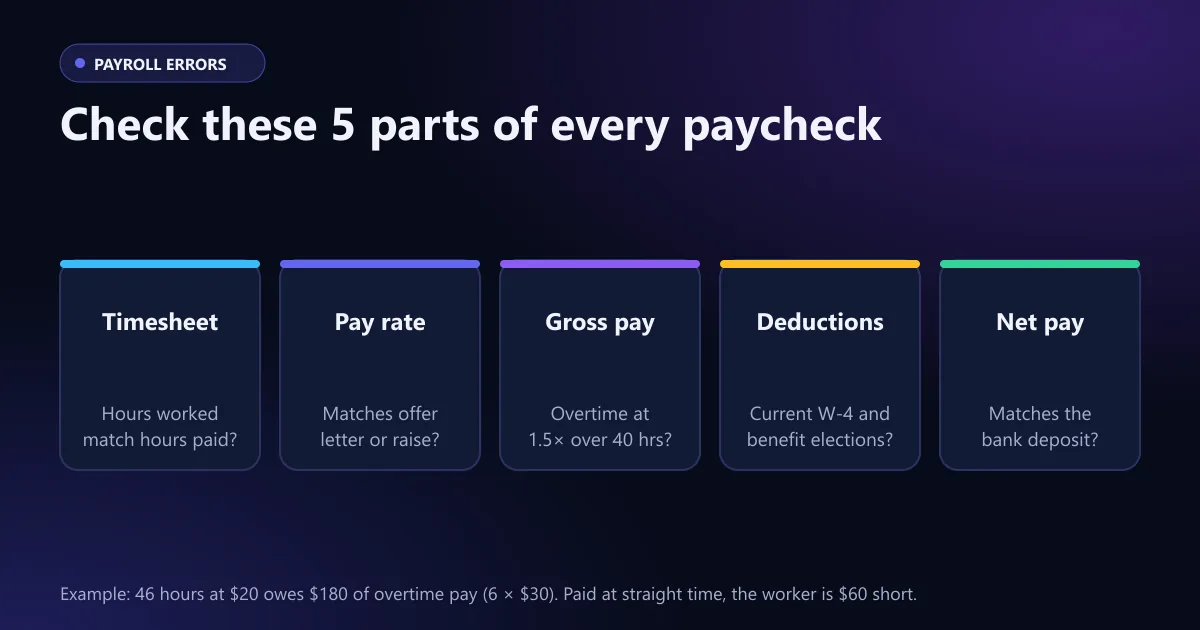
Finding a paycheck discrepancy early delivers 4 main benefits: employees receive correct wages, employers stay compliant with the Fair Labor Standards Act (FLSA), turnover drops, and tax filings stay accurate. Payroll and human resources (HR) teams use a paycheck discrepancy review in 3 main ways: to audit pay stubs before payday, to settle a payroll dispute, and to test pay equity across departments. Every review checks the same 5 components: the timesheet, the pay rate, gross pay, deductions, and net pay.
This guide explains what a pay discrepancy is, why to take pay discrepancy seriously, the 15 common payroll discrepancies and pay disparities, their root causes, the consequences of payroll errors, how to identify and fix pay disparities, how long a company has to fix a payroll error, and which practices and software prevent the next one.
Understanding Pay Discrepancies
Pay discrepancies fall into 2 groups: payroll discrepancies, which are processing errors on a single paycheck, and pay disparities, which are unexplained pay differences between employees in comparable roles.
What Is Pay Discrepancy?
A pay discrepancy is a difference between the compensation an employee is owed and the compensation the employee is paid. The term covers a paycheck discrepancy on one pay stub, such as a net pay shortfall of $180 after 6 hours of missing overtime pay, and a salary discrepancy between coworkers, such as two analysts with the same duties earning $62,000 and $71,000.
A paycheck discrepancy shows up in 6 records: the pay stub, the timesheet, the payroll record, the tax form, the bank statement, and the employment contract. Comparing these records reveals 4 common patterns:
- Gross-to-net mismatch: the deductions on the pay stub (or pay slip) do not add up to the difference between gross pay and net pay.
- Direct deposit variance: the bank statement shows a different amount than the pay stub.
- Pay rate discrepancy: the hourly rate or salary used in payroll differs from the rate in the offer letter or employment contract.
- Check amount discrepancy: the amount printed on the check differs from the amount earned for the pay period.
People use 5 synonyms for the same problem: pay error, wage discrepancy, salary discrepancy, payroll discrepancy, and compensation discrepancy.
To check whether your own deductions add up, compare your stub with an estimate from our paycheck calculator.
Pay Discrepancy vs Pay Gap vs Pay Variance
A pay discrepancy is an unexplained pay difference, a pay gap is a group-level statistic, and a pay variance is any difference between expected and actual pay.
| Term | Meaning | Example | Usual response |
|---|---|---|---|
| Pay discrepancy | A difference between pay owed and pay received, or between similar employees, with no valid reason | A warehouse worker is paid for 38 hours after working 42 | Payroll correction and back pay |
| Pay gap | The difference in average or median pay between two groups across a workforce | Median pay for women is 8% below median pay for men | Changes to hiring, promotion, and pay ranges |
| Pay variance | A difference between planned pay and actual pay, or between two pay periods | Net pay drops $85 after a health plan change | Review, then explain or correct |
A pay variance is often legitimate. A pay variance becomes a pay discrepancy when no policy, contract term, or approved change explains the difference. A pay gap contains pay discrepancies when role, experience, performance, and location fail to explain the group difference.
Why Take Pay Discrepancy Seriously?
Take pay discrepancy seriously for 5 reasons: lost productivity, talent drain, lawsuits, reputation damage, and turnover costs.
Lost Productivity From Systemic Pay Gaps
Systemic pay gaps lower output. Employees who believe pay is unfair spend work hours comparing salaries, checking pay stubs, and raising payroll disputes. Payroll staff lose time too: one off-cycle payment means recalculating gross pay, taxes, and deductions, then reissuing the pay stub. Ten corrections a month turn into a standing workload.
Talent Drain From Limited Growth Paths
Employees leave when raises and promotions follow no clear rule. High performers spot inequitable raise and promotion patterns first, and high performers receive outside offers first. Each exit removes job knowledge, client relationships, and training investment.
Costly Lawsuits and Compliance Violations
Unpaid wages create legal liability under the FLSA. An employee recovers back pay plus an equal amount in liquidated damages, which doubles the bill. The claim window is 2 years, or 3 years for a willful violation. There are 3 legal exposures to track:
- Wage and hour claims: the Department of Labor (DOL) Wage and Hour Division investigates complaints and reviews records for every affected employee, not only the person who filed.
- Equal pay claims: the Equal Pay Act (EPA) bars different pay for men and women doing equal work in the same establishment.
- State claims: state pay discrepancy law often adds penalties, and many states treat repeated underpayment as wage theft.
Damaged Reputation Blocking Top Hires
Pay problems become public. Employees describe a paycheck short by $200 on employer review sites, and wage claims enter public records. Candidates read both before applying. Pay transparency laws in states including Colorado, California, New York, and Washington require salary ranges in job postings, so applicants and current staff see inconsistent pay side by side.
Higher Turnover Cutting Into Profits
Turnover from pay errors adds 4 costs: recruiting fees, onboarding time, lost output while the seat is empty, and overtime for the remaining team. One incorrect paycheck weakens trust. Repeated payroll mistakes send employees to job boards.
Common Types of Payroll Discrepancies and Pay Disparities
There are 15 common payroll discrepancies and pay disparities: 10 are processing errors that affect a single paycheck, and 5 are structural pay differences between employees.
Incorrect Work Hours Recorded
Incorrect work hours produce a paycheck error before payroll even runs. There are 4 common timekeeping errors: missed punches, buddy punching, manual timesheet edits, and a timesheet rounding difference. Rounding a 7:53 a.m. clock-in to 8:00 a.m. removes 7 minutes, and across 20 shifts that equals 2 hours 20 minutes of missing wages. A pay period cutoff issue moves hours worked on the last day into the wrong period.
Overtime Mismanagement
The FLSA requires 1.5 times the regular rate for hours above 40 in a workweek for non-exempt employees (DOL overtime rules). There are 4 common overtime errors:
- Averaging hours across two weeks instead of counting each workweek alone.
- Leaving bonuses or a shift differential out of the regular rate.
- Refusing to pay overtime that was worked but not pre-approved.
- Applying the federal rule in a state with daily overtime, such as California.
An employee earning $20 an hour who works 46 hours is owed $180 in overtime pay (6 hours at $30). Paying those 6 hours at straight time leaves $60 in unpaid overtime. An overtime miscalculation check on each payroll run catches this error.
Tax Deduction Errors
A payroll tax withholding error comes from 3 sources: an outdated Form W-4, the wrong state or local tax code, and a missed wage base limit. Remote employees who move between states trigger tax withholding errors often. Pre-tax and post-tax deductions entered in the wrong order change taxable wages, and the mistake flows into the year-end Form W-2. A withholding error alert in payroll software flags a sudden change in tax withheld between pay periods. Our guide to FIT tax on a paycheck shows how to check the federal line yourself.
Employee Misclassification
Employee misclassification takes 2 forms: treating an employee as an independent contractor, and treating a non-exempt employee as exempt. The first form removes tax withholding, overtime, and benefits. The second form removes overtime. Both forms create back pay and back tax liability for every affected pay period.
Late or Missed Salary Payments
Late or missed salary payments come from 4 failures: bank file errors, missed approval deadlines, wrong account numbers, and holiday scheduling. A direct deposit error with one wrong digit sends pay to the wrong account or returns the payment days later. Most states set a required pay frequency, so a late payment is a wage law violation.
Benefits Mismanagement
Benefit deductions go wrong at 3 points: enrollment, life events, and termination. Examples include health premiums deducted at the family rate for single coverage, 401(k) contributions that continue past the annual limit, and a deduction error after a plan change. A garnishment error, such as withholding more than the court order allows or continuing after the debt is paid, belongs in this group. The DOL wage garnishment fact sheet sets out the federal limits.
Duplicate Payments
A duplicate payment pays an employee twice for the same period. Duplicate payments happen in 3 ways: a payroll run is submitted twice, an off-cycle payment repeats in the regular run, or one employee holds two profiles in the system. The reverse error is an expense reimbursement offset entered twice, which creates an underpayment.
Leave and Absence Errors
Leave and absence errors change paid hours. There are 4 common versions: paid time off (PTO) recorded as unpaid, unpaid leave recorded as paid, accrual balances left without updates, and missed holiday pay. Eight hours of vacation left off a paycheck at $25 an hour equals a $200 salary shortfall.
Currency Conversion Issues
Currency conversion issues affect employers that pay international staff. The 3 common causes are an exchange rate date that differs between the contract and the payment, transfer fees deducted from net pay, and rounding. A contract for $3,000 a month, paid in euros or pounds, pays a different local amount each month unless the contract fixes the rate source and the rate date.
Incorrectly Entering New Employees in the System
New hire setup errors affect the first paycheck. There are 5 fields that go wrong most: start date, pay rate, tax form details, bank account, and benefit elections. A wrong start date prorates the first salary payment incorrectly. A pay raise effective date error is the same problem later in employment: the new rate starts one pay period late and creates a retro pay gap.
Base Salary Gaps Between People in the Same Roles
Base salary gaps between people in the same roles are the most visible pay disparity. Two support specialists with the same title, level, location, and performance rating earning $48,000 and $55,000 have a $7,000 gap that needs a documented reason, such as tenure or a certification. A gap with no documented reason is a pay discrepancy.
Unequal Bonus and Incentive Distributions
Unequal bonus and incentive distributions appear when managers apply different rules to similar employees. There are 3 common disputes: a bonus proration dispute after a mid-year start or leave, a commission split error on a shared deal, and discretionary bonuses awarded without written criteria.
Different Benefits Packages for Similar Positions
Different benefits packages for similar positions create a gap in total compensation that base salary hides. Examples include different employer retirement matches, different PTO allowances, and car or phone allowances granted to some employees at the same level and not others.
Inequitable Raise and Promotion Patterns
Inequitable raise and promotion patterns widen small gaps every year. A 1-point difference in annual raises, 3% against 4%, turns a $60,000 salary into $69,556 or $73,000 after 5 years. Review time-to-promotion and average raise size by department, manager, and demographic group to find these patterns.
Inconsistent Starting Salary Offers
Inconsistent starting salary offers are the origin of most long-term salary gaps between people. Offers drift for 3 reasons: negotiation skill, a tight hiring market, and reliance on a candidate's past salary. A new hire brought in $10,000 above current staff creates pay compression on day one.
Root Causes of Payroll Discrepancies
Payroll discrepancies have 6 root causes: manual data entry, disconnected systems, unclear pay policies, late changes, complex rules, and untrained staff.
Common Causes in Payroll and Sales Compensation
The 6 common causes in payroll are:
- Manual data entry: retyping hours from a paper timesheet into payroll software produces a transposed digit or a manual adjustment error.
- Disconnected systems: time tracking, HR, benefits, and payroll each hold a different version of the same employee record.
- Unclear pay policies: managers interpret rounding, on-call pay, and travel time differently when no written rule exists.
- Late changes: a raise, transfer, or termination approved after the payroll cutoff misses the current run and creates a retro pay gap or a final paycheck error.
- Complex rules: multi-state taxes, union rates, tipped wages, and garnishments each carry separate calculations, and a tip credit shortfall goes unnoticed when tips fall below the minimum wage make-up amount.
- Untrained staff: payroll and HR teams apply last year's tax tables, limits, or overtime rules.
Sales compensation adds 4 causes:
- Commission split errors: two representatives share a deal, and the plan credits one of them with 100%.
- Mid-period plan changes: a quota or rate changes in the middle of a quarter, and the payout formula uses the wrong version.
- Crediting delays: a deal closes on the last day of the month and lands in the next commission period.
- Clawback mistakes: a refunded deal reverses more commission than the plan allows.
Two events concentrate errors: termination and off-cycle pay. A severance pay mismatch appears when the separation agreement and the payroll entry show different amounts. An off-cycle payment discrepancy appears when a manual check skips the normal tax and deduction logic.
Consequences of Payroll Errors
The consequences of payroll errors fall into 3 groups: harm to employees, financial and legal penalties, and damage to the organization. A fourth consequence arrived in 2026: overtime errors now reach the Form W-2.
Employee-Related Consequences
Payroll errors hurt employees in 4 ways:
- Cash shortfall: an underpayment of $150 causes a missed rent payment, an overdraft fee, or a late bill.
- Tax problems: wrong withholding produces an unexpected tax bill or a delayed refund.
- Benefit gaps: a missed premium deduction lapses coverage, and a missed 401(k) deferral loses the employer match.
- Lost trust: employees start checking every pay stub and question the employer's competence.
Financial and Legal Consequences
Payroll errors cost employers in 5 ways:
- Back pay: all unpaid wages for up to 2 years, or 3 years for willful violations under the FLSA.
- Liquidated damages: an amount equal to the back pay, which doubles the total.
- Tax penalties: the Internal Revenue Service (IRS) charges failure-to-deposit penalties of 2% to 15% on late or short payroll tax deposits.
- State penalties: California, for example, sets pay stub penalties of $50 for a first violation and $100 for each later violation per employee, up to $4,000.
- Legal fees: a losing employer pays the employee's attorney fees in an FLSA case.
Overpayments cost money too. Recovering a duplicate payment takes staff time, and state law limits how much an employer deducts from a later paycheck.
Organizational Impact
Payroll errors damage the organization in 3 ways. HR and payroll teams spend hours on corrections instead of planned work. Finance reports wrong labor costs, which distorts budgets and job costing. Managers lose credibility when the same team reports a payroll problem every month.
New Overtime Reporting Requirement
Employers must report qualified overtime compensation separately on Form W-2, in Box 12 with code TT, starting with tax year 2026. The first forms with this code go to employees in early 2027.
The requirement comes from the One Big Beautiful Bill Act (OBBBA), which created a federal income tax deduction for qualified overtime for tax years 2025 through 2028, capped at $12,500 for single filers and $25,000 for joint filers. There are 4 facts payroll teams need:
- Qualified amount: only the FLSA overtime premium counts, which is the "half" in time-and-a-half. An employee earning $20 an hour who works 100 overtime hours receives $3,000 in overtime pay, and $1,000 of that is qualified overtime.
- State overtime: overtime owed only under state law, such as daily overtime, does not count.
- Transition relief: the IRS waived penalties for tax year 2025, and that relief has ended.
- Corrections: an employee cannot fix a wrong amount on a tax return. The employer must issue a Form W-2c, and incorrect reporting carries information return penalties.
An overtime miscalculation now creates 2 errors: a wrong paycheck and a wrong Form W-2. Track FLSA overtime and state overtime in separate pay codes before year-end.
How to Know if You Have a Pay Discrepancy Problem
You have a pay discrepancy problem when 7 warning signs appear in your payroll and HR data:
- Payroll runs more than 1 or 2 off-cycle corrections per pay period.
- Employees report the same paycheck discrepancy issues each month, such as missing overtime or a wrong deduction.
- Total hours on timesheets differ from total hours paid.
- Quarterly tax filings need amendments, or Forms W-2c go out every January.
- Employees in the same role and level show a salary spread above 15% to 20% with no documented reason.
- New hires earn more than tenured employees in the same job.
- Exit interviews name pay as a reason for leaving.
One sign calls for a spot check. Three or more signs call for a full paycheck discrepancy audit.
How to Identify Pay Discrepancy in Your Company
To identify pay discrepancy in your company, follow 5 steps: collect compensation data, run audits, map pay ranges, review hiring and promotion patterns, and analyze pay by demographics.
Step 1: Collect Detailed Compensation Data
Collect detailed compensation data for every employee in one file. Include 8 fields: job title, level, department, location, hire date, base salary or hourly rate, bonus and commission paid in the last 12 months, and benefits value. Add performance rating and manager name for the equity analysis in Step 5. Pull pay figures from the payroll record, not from offer letters, so the data shows actual pay.
Step 2: Run Regular Compensation Audits
Run regular compensation audits on 2 tracks. The payroll track is a paystub variance audit: compare each employee's gross pay, deductions, and net pay against the prior period and flag changes above a set threshold, such as 10%. The equity track compares pay for employees in the same role and level once or twice a year. Record each finding with the cause, the amount, and the correction date.
Step 3: Map Out Your Pay Ranges
Map out your pay ranges by placing every employee inside the minimum, midpoint, and maximum for the job level. Calculate the compa-ratio, which is salary divided by the range midpoint. A compa-ratio below 0.80 or above 1.20 marks an outlier to review. Jobs with no defined range are the first gap to close.
Step 4: Review Hiring and Promotion Patterns
Review hiring and promotion patterns for the last 24 to 36 months. Compare 4 measures across departments and managers: starting salary against the range midpoint, time to first promotion, average raise percentage, and the share of employees promoted. A manager whose offers land 12% above midpoint while peers land at midpoint is a source of future pay discrepancy.
Step 5: Analyze Pay by Demographics
Analyze pay by demographics after grouping employees who do comparable work. Compare median pay by gender, race or ethnicity, and age band within each group. Control for legitimate factors, including tenure, location, and performance, using a regression analysis for groups above roughly 30 employees. Involve legal counsel before the analysis starts, so the findings and the remediation plan are handled correctly.
How to Investigate and Resolve Pay Discrepancies
To investigate and resolve pay discrepancies, run a 5-step paycheck discrepancy process for each report, then apply 6 permanent fixes.
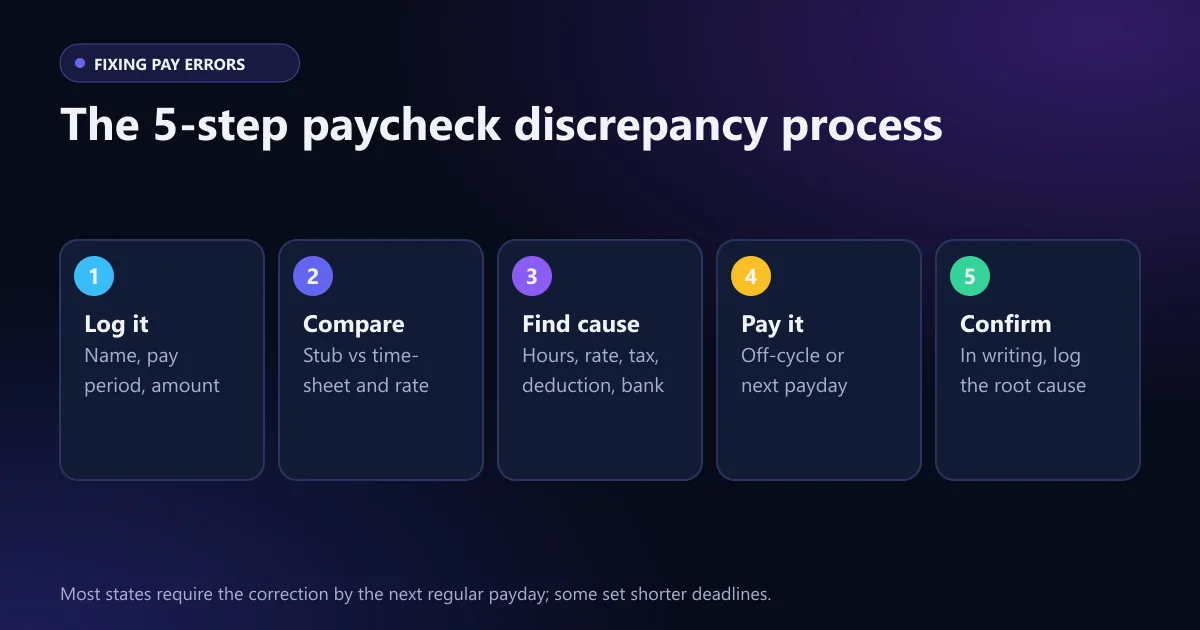
The paycheck discrepancy investigation has 5 steps:
- Log the paycheck discrepancy report with the employee name, pay period, and amount in question.
- Compare the pay stub against the timesheet, the pay rate on file, and the deduction elections.
- Identify the cause: hours, rate, tax, deduction, or bank file.
- Calculate the paycheck discrepancy correction, including taxes, and pay the paycheck discrepancy adjustment by off-cycle payment or on the next payday, as state law requires.
- Confirm the fix with the employee in writing and record the root cause.
Upgrade to Automated Payroll Systems
Automated payroll systems calculate gross pay, taxes, and deductions from rules instead of manual entry. ADP, Paychex, Gusto, QuickBooks Payroll, and Workday update federal and state tax tables, apply overtime rules, and file payroll taxes. Automation removes 3 error sources: retyped numbers, outdated tax rates, and forgotten deductions.
Conduct Regular Payroll Audits
Regular payroll audits catch errors before employees do. Run a pre-payroll check each pay period and a full payroll audit each quarter. A paycheck discrepancy audit covers 6 checks:
- Active employee list against HR records, to find terminated employees still paid.
- Hours paid against hours recorded.
- Pay rates against signed offer letters and raise approvals.
- Overtime calculations against the FLSA and state rules.
- Tax withholding against current Forms W-4 and work locations.
- Net pay against bank file totals.
Use Accurate Time-Tracking Systems
Accurate time-tracking systems record hours at the source and send time data to payroll without retyping. Choose a system with 4 controls: identity verification at clock-in, location verification, automatic break and overtime rules, and manager approval before export. Employees who review and sign off on a timesheet each period dispute fewer paychecks.
Implement Transparent Communication Channels
Transparent communication channels give employees one known place to report a discrepancy on a paycheck. Set up a dedicated payroll inbox or ticket form, publish a response time such as 2 business days, and explain each pay stub line in the employee handbook.
Employees get faster answers with a clear payroll discrepancy email. Use this pay discrepancy email template:
Train Payroll and HR Teams
Train payroll and HR teams on 4 topics each year: FLSA overtime and exemption rules, state wage payment laws for every work location, tax and benefit limit changes, and the company's own pay policies. Train managers to approve timesheets on time and to send pay changes before the cutoff.
Collaborate With Experts
Collaborate with experts when the issue exceeds in-house knowledge. There are 3 experts to call: an employment attorney for misclassification, pay equity findings, or a DOL inquiry, a certified public accountant (CPA) for payroll tax corrections, and a compensation consultant for pay range design. Expert review before a correction costs less than a penalty after a wrong one.
How Long Does a Company Have to Fix a Payroll Error?
A company has until the next regular payday to fix a payroll error in most states, and some states set a shorter deadline. Federal law sets no fixed number of days. The FLSA requires wages on the regular payday for the pay period worked, so an underpayment is already late on the day it happens, and the DOL expects correction as soon as practicable.
State law sets the specific deadline. Three examples show the range:
| State | Rule for correcting an underpayment |
|---|---|
| Oregon | Next regular payday for an undisputed underpayment below 5% of gross wages. Three business days after notice for an underpayment of 5% or more. |
| Florida | 15 calendar days after written notice to resolve a minimum wage underpayment before the employee files suit. |
| California | Final wages are due at termination. A willful delay adds a waiting time penalty of one day's pay per day late, up to 30 days. |
Check the state labor agency for each work location, since paycheck discrepancy law differs by state.
Employees have deadlines too. An FLSA paycheck discrepancy claim must be filed within 2 years of the violation, or 3 years for a willful violation. State wage claims carry separate limits.
A paycheck error in the employee's favor works differently. The overpaid amount belongs to the employer, and the employee must return it. Employers recover an overpayment in 3 ways: a lump-sum repayment, a deduction from the next paycheck, or deductions spread across several pay periods. State law controls the method, and several states require written consent or cap each deduction. Employees who notice an overpayment protect their paycheck discrepancy rights by reporting the error in writing and keeping the money untouched until payroll confirms the repayment plan.
Best Practices for HR and Employers
There are 5 best practices for HR and employers: design data-driven pay bands, automate compensation reviews, create transparent total rewards visibility, implement systematic offer management, and monitor with advanced analytics.
Design Data-Driven Pay Bands
Design data-driven pay bands from 2 inputs: market salary surveys and internal job levels. Set a minimum, midpoint, and maximum for each level, with a spread of 30% to 50% from minimum to maximum for most professional roles. Refresh the bands once a year. Pay bands give every salary decision a reference point, which narrows salary gaps between people in the same role.
Automate Compensation Reviews
Automate compensation reviews so that raise and bonus cycles follow one set of rules. Compensation software applies eligibility dates, budget limits, and merit guidelines to every manager's recommendations and flags exceptions for approval. Automation replaces emailed spreadsheets, which hold broken formulas and outdated salary data.
Create Transparent Total Rewards Visibility
Create transparent total rewards visibility by giving each employee a statement that lists 5 items: base pay, bonus, equity, benefits value, and employer retirement contributions. Share the pay range for the employee's level and the criteria for moving within the range. Employees who see how pay is set raise fewer payroll disputes.
Implement Systematic Offer Management
Implement systematic offer management to stop inconsistent starting salary offers. Apply 3 rules: base every offer on the pay band and the candidate's skills, not on past salary, compare each offer against current employees in the same role before approval, and require a second approval for any offer above the range midpoint.
Monitor With Advanced Analytics
Monitor with advanced analytics between formal audits. Track 5 metrics on a dashboard: compa-ratio by group, pay gap by demographic, payroll error rate per pay run, number of off-cycle payments, and average days to resolve a payroll dispute. A paycheck discrepancy analysis each quarter shows whether fixes hold.
How Technology Can Help Prevent Pay Discrepancies
Technology prevents pay discrepancies at 2 points: time and attendance software fixes the hours that enter payroll, and compensation software fixes the pay decisions behind each salary. Payroll platforms sit between the two and calculate the paycheck.
Time and attendance tools reduce incorrect work hours with features such as identity-verified clock-in to stop buddy punching, location-based clock-in limits, shift and break rules applied automatically, and payroll-ready timesheet exports. They fit employers whose paycheck discrepancies start with time data, such as construction contractors and facility operators with staff across sites.
Compensation management tools address pay disparities in salary, bonus, and offer decisions. Common features include rule-based salary review cycles, pay range modeling by level and location, pay equity dashboards, bonus and incentive calculations, total rewards statements, and offer builders that compare candidates against internal pay data. These tools suit mid-sized and large organizations with complex pay cycles. Smaller employers get similar results from pay bands, a documented offer policy, and a yearly pay equity review.
Conclusion
A paycheck discrepancy is a difference between the pay an employee earned and the pay the employee received, or a difference between the pay of two people who do the same work. Payroll errors come from hours, rates, taxes, and deductions. Pay disparities come from offers, raises, bonuses, and benefits.
Fixing a paycheck discrepancy early delivers the same 4 benefits every time: correct wages, FLSA compliance, lower turnover, and accurate tax filings. Check the 5 components of every paycheck: the timesheet, the pay rate, gross pay, deductions, and net pay. Run regular compensation audits, correct underpayments by the legal deadline, and take pay discrepancy seriously before a small error becomes a wage claim.
Start with one action this week: compare last period's hours paid against hours recorded for every employee.
Frequently Asked Questions
How Often Should Payroll Audits Be Conducted?
Payroll audits should be conducted every pay period as a short pre-payroll check and every quarter as a full audit. Add an annual audit before Form W-2 filing. Companies with hourly staff, multi-state employees, or recent system changes run the full audit monthly.
What Is the Most Effective Way to Prevent Payroll Discrepancies?
The most effective way to prevent payroll discrepancies is to connect time tracking directly to an automated payroll system and remove manual data entry. Support the integration with 3 habits: a pre-payroll variance review, a firm cutoff date for pay changes, and employee sign-off on timesheets.
How Can HR Teams Resolve Disputes Related to Payroll?
HR teams resolve disputes related to payroll with a 5-step paycheck discrepancy procedure: log the report, compare the pay stub with the timesheet and pay rate, identify the cause, pay the correction, and confirm in writing. Publish a response time, such as 2 business days, and keep a record of each payroll dispute and its root cause.
What Features Should Employers Look for in Payroll Software?
Employers should look for 6 features in payroll software: automatic tax table updates, overtime rules by state, time and attendance integration, variance alerts before each run, employee self-service pay stubs, and an audit trail of every change. Employers with overtime staff need separate pay codes for FLSA overtime to meet the Form W-2 Box 12 code TT requirement.
What Steps Should Employers Take if Faced With Legal Issues Due to Payroll Errors?
Employers faced with legal issues due to payroll errors should take 5 steps: contact an employment attorney, preserve all payroll records and timesheets, calculate the back pay owed, correct the error for every affected employee, and fix the root cause. Do not retaliate against the employee who raised the issue. The FLSA prohibits retaliation.
How Can I Identify and Fix Pay Disparities Across Departments Without Manual Spreadsheet Analysis?
Identify and fix pay disparities across departments with compensation software that pulls data from your HR system, groups employees by role and level, and flags outliers automatically. The software calculates compa-ratios and pay gaps for each department and models the cost of each adjustment. Apply the adjustments in the next compensation review cycle.
How Can I Resolve Salary Discrepancies in the Bakery Industry?
Resolve salary discrepancies in the bakery industry by fixing time records first, since most bakery pay errors come from early shifts, split shifts, and overtime. Take 4 actions: use a time clock instead of paper sheets, pay overtime for every hour above 40 in a workweek, apply any night or early-morning shift differential consistently, and set one pay range per role for bakers, decorators, and counter staff. Check tip pooling and tip credit rules for counter staff who receive tips.
Are Employees Held Accountable for Cash Discrepancies?
Yes, employees are held accountable for cash discrepancies through discipline, but the law limits wage deductions for a cash shortage. Under the FLSA, a deduction for a register shortage cannot reduce pay below the federal minimum wage or cut into overtime pay. Several states, including California, prohibit deductions for cash shortages unless the loss came from dishonesty or gross negligence. Use cash handling training and till audits before deductions.
How Can We Identify and Fix Pay Disparities Across Our Organization and Different Employee Groups?
Identify and fix pay disparities across your organization with a pay equity audit: group employees who do comparable work, compare pay by gender, race or ethnicity, and age, and control for tenure, location, and performance. Fix unexplained gaps by raising the lower-paid employees' pay. The Equal Pay Act prohibits lowering anyone's pay to close a gap. Repeat the audit every year.
A Highly Experienced Candidate Is Offered Much More Than Existing Employees in the Same Job. How Can This Be Resolved Fairly?
Resolve this pay disparity fairly by testing the offer against the pay band, then adjusting existing employees whose pay falls short for their experience. Follow 4 steps:
- Confirm the candidate's experience justifies a higher position in the range, or a higher job level.
- Hire at the higher level, if the experience matches that level.
- Review current employees in the role and raise pay for those with comparable experience and performance.
- Document the reason for any remaining difference.
What Is a Pay Discrepancy?
A pay discrepancy is a difference between the pay an employee is owed and the pay the employee receives, or an unexplained pay difference between employees doing similar work. Pay discrepancies at work include missing overtime, wrong deductions, and unequal salaries for the same role.
What Is the Meaning of Salary Discrepancy?
Salary discrepancy means a salaried employee's pay differs from the agreed amount or from the pay of comparable coworkers without a valid reason. A salary mismatch between the offer letter and the first paycheck is one example. A $9,000 gap between two employees with the same role, level, and performance is another.
What Is an Example of Payroll Discrepancy?
An example of payroll discrepancy is an employee who works 45 hours in a week at $18 an hour and is paid 45 hours at straight time. The employee receives $810 and is owed $855, since 5 overtime hours pay $27 each. The $45 difference is unpaid overtime that the employer owes as back pay.
Articles are general information for US employees and are not tax, legal or financial advice. Tax rules change; check the official IRS or state sources linked on our homepage.